Solar Pump for Agriculture in India | Best Prices & Subsidy
Upgrade your farm with a high-efficiency solar pump for agriculture in India. Our solar water pump solutions are perfect for irrigation, reducing electricity bills and dependence on erratic power. Learn about government subsidies like the PM KUSUM scheme to make your investment more affordable.
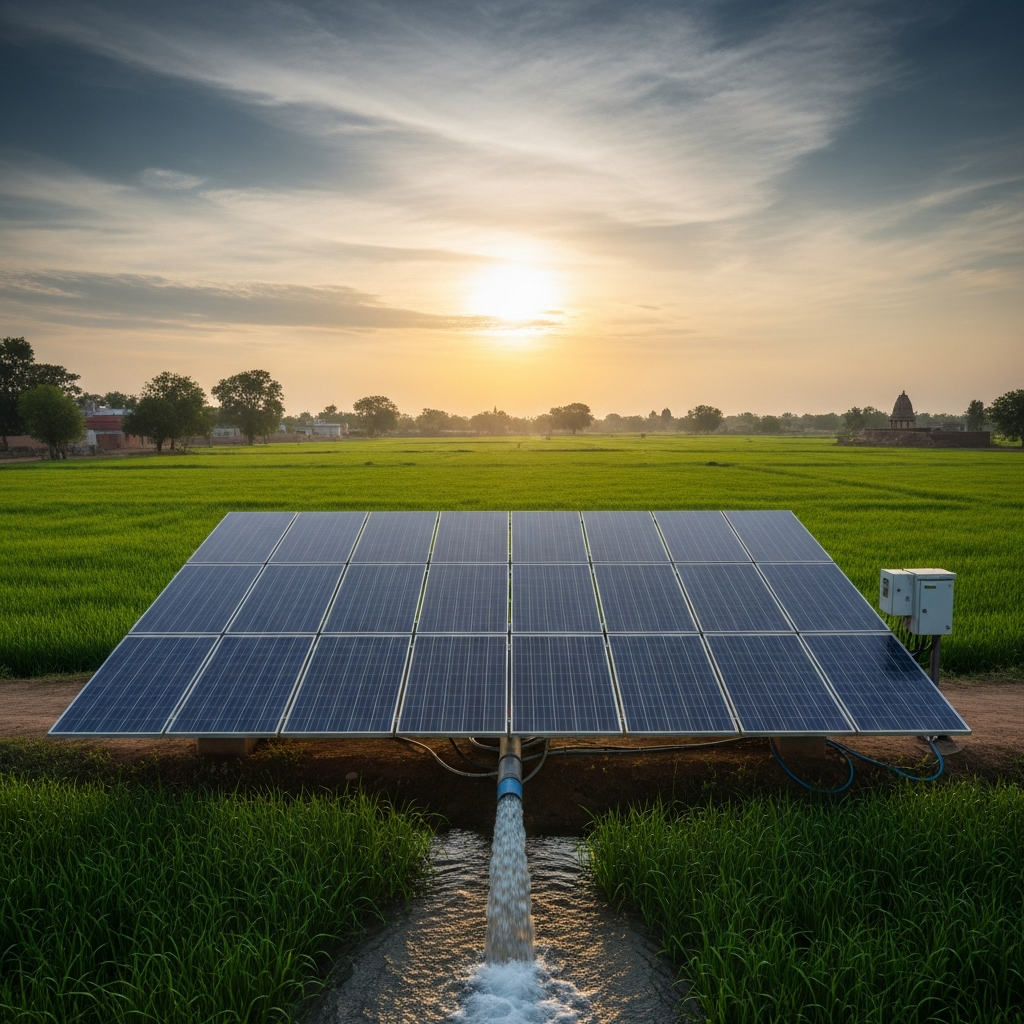
- Section 1: Unlocking Water Independence: Why Your Home & Farm Need a Solar Pump
- Section 2: Demystifying the Technology: A Simple Guide to How Solar Pumps Work
- Section 3: Sizing and Selection: A Step-by-Step Guide to Your Perfect System
- Section 4: From Purchase to Pumping: Installation, Maintenance, and Government Support
- Section 5: Top 3 Product Comparison & Final Checklist
- Conclusion
- Frequently Asked Questions (FAQ)
- What is the cost of a solar pump in India and can I get a government subsidy?
- How do solar pumps perform on cloudy days or during the monsoon?
- What kind of maintenance is required for a solar water pump?
- ⚡ Get 3 Free Solar Quotes
Key Takeaways: 1. Achieve Water Independence: A solar pump frees you from unreliable electricity grids and the ever-increasing cost of diesel, giving you complete control over your water supply. 2. Sizing is Simple: Your perfect system depends on two key factors: your daily water requirement (Litres Per Day) and the total pumping height (Total Head). 3. Subsidies Make It Affordable: The Government of India's PM-KUSUM scheme can cover a significant portion of the initial cost, making this a highly accessible investment for landowners.
Section 1: Unlocking Water Independence: Why Your Home & Farm Need a Solar Pump
1.1 The Modern Indian Landowner's Dilemma
If you own a farmhouse or a plot of land in India, you know the struggle. You are constantly battling forces outside your control just to get water where you need it.
- The Unreliable Grid: Frequent power cuts, maddening voltage fluctuations, and scheduled load-shedding are a reality in semi-urban and rural India. This makes your traditional electric pump useless when you need it most.
- Skyrocketing Costs: The alternative isn't much better. The price of diesel for generators keeps climbing. A grid-powered 3 HP pump running for just a few hours daily can easily add ₹3,000 - ₹5,000 to your monthly electricity bill.
- Depleting Water Tables: As groundwater levels drop, you need more power to lift water from greater depths. This puts even more strain on your wallet and the grid, creating a vicious cycle.
1.2 The Solar Pump Solution: A Revolution in Your Backyard
Imagine a pump that runs on free, clean energy from the sun, making you completely independent of the grid for your water needs. That is the power of a solar water pump.
Here are the core benefits tailored for you:
- Zero Operational Cost: Once installed, your fuel is the sun. There are no electricity bills and no diesel expenses. The sun literally pays the bill for your water.
- Energy Independence: You can pump water whenever the sun shines. No more waiting for the power company or rushing to the diesel bunk. You are in command of your water supply.
- Low Maintenance: A solar pump system has very few moving parts compared to a diesel generator. This means minimal upkeep and a long, hassle-free life. For more on keeping the panels efficient, check out these essential solar panel maintenance tips.
- Eco-Friendly & Sustainable: This is a green investment you can be proud of. You reduce your carbon footprint and contribute to a healthier environment.
- Increased Property Value: A self-sufficient, modern water source is a massive asset. A solar pump system significantly enhances the value and appeal of your farmhouse or agricultural land.
1.3 Is It Right For You? A Quick Self-Assessment Checklist
Answer these simple questions:
- Do you own a borewell, open well, pond, or have access to a nearby stream?
- Do you face frequent power cuts (more than 2 hours a day)?
- Is your property located in an area with no grid connection?
- Are your monthly water pumping costs exceeding ₹2,000?
- Do you have a clear, shadow-free area (at least 100 sq. ft.) for solar panels?
If you answered 'Yes' to two or more of these, a solar pump is not just an option—it's the solution you've been looking for.
Section 2: Demystifying the Technology: A Simple Guide to How Solar Pumps Work
A solar pump system isn't black magic; it's a straightforward combination of three key parts working in harmony.
2.1 The Three Core Components Explained
- Solar Panels (The Powerhouse): These are the heart of your system. They capture sunlight and convert it directly into DC electricity. For the Indian climate, both Monocrystalline (slightly more efficient and expensive) and Polycrystalline (excellent value) panels work great. They must be mounted on a sturdy, rust-proof, south-facing structure to capture maximum sunlight.
- Controller (The Brain): This smart device manages the flow of power from the panels to the pump motor. It optimizes performance using MPPT (Maximum Power Point Tracking) technology to squeeze every watt out of the sunlight. Look for controllers with dry run protection (stops the pump if the well is empty) and overload protection.
- The Pump (The Heart): This is the component that actually moves the water. It consists of a motor and a pump mechanism. The main choice you'll make is between two types.
- Submersible Pumps: Designed to be placed deep inside the water source, perfect for borewells.
- Surface Pumps: Sit on the ground near the water source, ideal for pulling water from ponds, tanks, or shallow wells.
2.2 Choosing the Right Pump Type: Submersible vs. Surface
Use this simple table to decide what's best for your property:
| Feature | Submersible Pump | Surface Pump |
|---|---|---|
| Best For | Borewells, deep wells (>30 ft) | Ponds, rivers, tanks, shallow wells (<30 ft) |
| Installation | Inside the water source | On the ground, near the water source |
| Priming | Not required | Self-priming or requires manual priming |
| Homeowner Use Case | Extracting groundwater for the entire property | Pumping water from a storage tank to a garden/farm |
2.3 AC vs. DC Pumps: What Your Installer Will Recommend
- DC Pumps: These are the most common choice for homeowners and small farms (up to 3 HP). They are highly energy-efficient and run directly on the DC power produced by solar panels, requiring no extra conversion.
- AC Pumps: These are more powerful (5 HP and above) and require an inverter (called a VFD) to convert the panels' DC power to AC. They are typically used for large-scale agriculture. The power systems for these are substantial, much like understanding if solar panels can run a 1.5 ton AC, it's about matching power generation to a heavy load.
For most farmhouse applications, a DC pump is the more efficient and cost-effective choice.
2.4 The Importance of Water Storage
The sun doesn't shine at night, but you still need water. The solution is simple: Pump when the sun shines, use water anytime.
Integrating your solar pump with a large overhead or ground-level storage tank (like a Sintex or RCC tank) is crucial. This ensures you have a reliable water supply 24/7, effectively making your tank a "water battery." While a pump stores water, understanding energy storage is key for full home solar solutions; you can learn more by comparing LiFePO4 vs lead-acid solar batteries.
Section 3: Sizing and Selection: A Step-by-Step Guide to Your Perfect System
Choosing the right size is critical. Don't worry, it's easier than it sounds. Follow these steps.
3.1 Step 1: Calculate Your Daily Water Requirement (Litres per Day - LPD)
Use this simple chart to estimate your needs:
- For Household Use: 135 litres x Number of People
- For Livestock: 50 litres x Number of Cattle
- For Garden/Lawn (Drip): 4 litres per square meter
- For 1 Acre Farm (Vegetables, Drip): ~25,000 litres
- For 1 Acre Farm (Paddy, Flood): ~80,000 - 1,00,000 litres
Example: A family of 4 with a 1-acre vegetable garden needs: (135 x 4) + 25,000 = 540 + 25,000 = 25,540 LPD.
3.2 Step 2: Determine the "Total Head" (The Pumping Height)
This is the total height the pump needs to push the water. It has two parts:
- Static Head: The simple vertical distance (in meters) from the water level in your well/borewell to the inlet of your storage tank.
- Friction Loss: Resistance from pipes and bends. As a simple rule of thumb, add 10-15% to your Static Head to account for this.
Actionable Advice: The easiest way to get this number is to ask your local plumber or the person who drilled your borewell. They will know your static water level and borewell depth.
3.3 Step 3: Assess Your Location and Sunlight
You need a spot for your solar panels that is completely shadow-free, especially between 9 AM and 4 PM.
As a general rule, you need about 100 sq. ft. of space for every 1 kW of solar panels. India is blessed with ample sunlight, but "peak sun hours" vary slightly by region, which your installer will account for.
3.4 Step 4: Putting It All Together - A Sizing Rule-of-Thumb Table
This table gives you a clear idea of what to expect based on your needs.
| Application | Required Water (LPD) | Typical Head | Recommended Pump (HP) | Approx. Solar Panels (kWp) | Estimated Cost (₹, unsubsidized) |
|---|---|---|---|---|---|
| Large Garden & Home | 5,000 - 10,000 | 30-50m | 1 HP | 1.2 kWp | ₹ 80,000 - 1,20,000 |
| 1-2 Acre Farm (Drip) | 20,000 - 40,000 | 40-60m | 2-3 HP | 2.5 - 3.5 kWp | ₹ 1,50,000 - 2,50,000 |
| 2-5 Acre Farm (Flood) | 50,000 - 1,00,000 | 50-80m | 5 HP | 5 - 6 kWp | ₹ 3,00,000 - 4,50,000 |
Section 4: From Purchase to Pumping: Installation, Maintenance, and Government Support
4.1 Navigating Government Subsidies: The PM-KUSUM Scheme
This is the most important step to make your solar pump affordable. The Pradhan Mantri Kisan Urja Suraksha evam Utthaan Mahabhiyan (PM-KUSUM) scheme's Component-B is designed for individual landowners like you.
- Subsidy Structure: While it varies by state, a common structure is:
- 30% Subsidy from the Central Government
- 30% Subsidy from the State Government
- 30% Loan from a bank
- 10% Your initial contribution
- How to Apply: You must apply through your state's official renewable energy agency portal. You will typically need your Aadhaar card, land records (like 7/12 extract), and bank details.
CRITICAL WARNING: Beware of fraudulent websites! Only use the official government portals for your state. Do not pay any "registration fees" to private websites.
4.2 Finding a Reputable Installer
- Look for empaneled vendors: Choose an installer who is officially listed with your state's renewable energy agency or the Ministry of New and Renewable Energy (MNRE).
- Check local references: Ask for contact details of previous installations in your area and speak to those customers.
- Get a detailed quote: Insist on a written quote that breaks down the cost of every component (panels, pump, controller, structure, wires) and includes installation and warranty details.
4.3 The Installation Process: What to Expect
A professional installation is typically a quick, 3-day process:
- Day 1: Site survey and construction of the concrete foundation for the panel mounting structure.
- Day 2: Mounting the solar panels and installing the pump inside your borewell or well.
- Day 3: Wiring the controller, panels, and pump together. The system is then tested and commissioned.
4.4 "Set It and Forget It" Maintenance
Solar pump systems are incredibly low-maintenance.
- Weekly: A quick visual check to ensure everything is running smoothly.
- Monthly: Clean the solar panels. Use a soft cloth and plain water in the early morning or late evening to wipe away dust and bird droppings. This simple step is crucial for peak performance. For a comprehensive guide, review these top solar panel maintenance tips.
- Yearly: It's a good practice to have a professional check all electrical connections and the pump's health once a year.
Section 5: Top 3 Product Comparison & Final Checklist
5.1 Crucial Factors for Comparison
When choosing a brand, focus on these five things:
- Brand Reputation & Service Network: Can you easily get service in your local area?
- Pump & Motor Efficiency: Higher efficiency means more water pumped for the same amount of sunlight.
- Controller Features: Does it offer all the necessary protections (dry run, overload)?
- Warranty: Check the separate warranties for panels (often 25 years), the pump, and the controller (typically 1-5 years).
- Price: The total system cost after considering all other factors.
5.2 Top 3 Solar Pump Models/Brands for Indian Homeowners
| Feature | The Workhorse: Shakti Solar Pumps | The Premium Performer: Grundfos SQFlex | The Value Champion: Lubi Solar Pumps |
|---|---|---|---|
| Pump Type | Submersible & Surface (AC/DC) | Submersible & Surface (Helical/Centrifugal) | Submersible & Surface (AC/DC) |
| Best For | Homeowners wanting a robust, widely available Indian brand with a massive service network. | Those seeking the highest efficiency, reliability, and advanced features, and are willing to pay a premium. | Budget-conscious buyers wanting a reliable product with good performance and widespread dealer access. |
| Key Features | - Made in India - Extensive range from 1HP to 100HP - Strong presence in PM-KUSUM scheme |
- Exceptionally high motor efficiency - Built-in dry-run protection - Can run on both AC/DC power sources |
- Excellent value for money - Strong cast iron/stainless steel construction - Good dealer network in rural India |
| Pros | - Excellent service network - Easy availability of spares - Competitive pricing |
- Top-tier performance in low light - Extremely long lifespan - Compact and easy to install |
- Very affordable - Durable and reliable for the price - Simple, no-frills operation |
| Cons | - May not be as efficient as premium international brands | - Significantly higher initial cost | - Controller features might be basic compared to others |
| Approx. Price (2HP) | ₹ 1,60,000 - 1,90,000 | ₹ 2,20,000 - 2,60,000 | ₹ 1,50,000 - 1,80,000 |
| Check Price | Buy Shakti Solar Pumps | Buy Grundfos Solar Pumps | Buy Lubi Solar Pumps |
5.3 Your Final Purchase Checklist
Before you sign the cheque, make sure you can tick every box:
- [ ] Have you calculated your daily water needs (LPD)?
- [ ] Do you know your total head (in meters)?
- [ ] Have you identified a shadow-free spot for the panels?
- [ ] Have you checked your eligibility for the PM-KUSUM scheme on the official government portal?
- [ ] Have you received written quotes from at least two reputable, empaneled installers?
- [ ] Does the quote clearly state the warranty for the pump, motor, controller, and panels?
5.4 Conclusion: Your Investment in a Water-Secure Future
Choosing a solar pump is more than just a purchase. It is a one-time investment in self-reliance, financial savings, and peace of mind. You are investing in a future where you have complete control over your most precious resource: water.
Take the first step today and declare your independence from the grid.
Conclusion
The adoption of solar water pumps is no longer a niche alternative but a mainstream revolution powering the future of Indian agriculture. By shifting from unreliable grid electricity and expensive diesel to the clean, abundant power of the sun, farmers are unlocking a new era of self-reliance, profitability, and sustainability. Government initiatives like the PM-KUSUM scheme are acting as powerful catalysts, making this transformative technology accessible and affordable. As India moves towards its goals of energy security, water conservation, and doubling farmer income, the solar pump stands as a cornerstone technology—a simple yet profound solution that empowers farmers, protects the environment, and ensures a brighter, greener, and more prosperous future for the nation's agricultural heartland.
Frequently Asked Questions (FAQ)
What is the cost of a solar pump in India and can I get a government subsidy?
The cost of a solar pump system in India varies widely based on its capacity (HP), type (submersible or surface), and brand, typically ranging from ₹1.5 lakh to ₹5 lakh. However, the Indian government provides significant financial assistance through the Pradhan Mantri Kisan Urja Suraksha evam Utthaan Mahabhiyan (PM-KUSUM) scheme. Under this scheme, farmers can receive central and state subsidies that often cover 60-90% of the total cost, making the initial investment far more manageable. It is best to contact your state's agriculture or renewable energy development agency for precise subsidy details.
How do solar pumps perform on cloudy days or during the monsoon?
While solar pumps operate at peak efficiency in bright, direct sunlight, modern systems are designed to function even in low-light conditions. Performance will be reduced on heavily overcast days, but they can still pump water, albeit at a lower flow rate. Most solar pump controllers use a Variable Frequency Drive (VFD), which automatically adjusts the pump's speed based on the amount of solar energy available, maximizing water output throughout the day. This ensures that farmers can still get a degree of irrigation done even when the weather is not ideal.
What kind of maintenance is required for a solar water pump?
Solar water pumps are known for their very low maintenance requirements, which is a major advantage over diesel pumps. The primary task is to regularly clean the solar panels with a soft cloth and water to remove dust, leaves, or bird droppings, ensuring they absorb maximum sunlight. Beyond that, a periodic check of the wiring and connections is recommended. The pump unit itself requires the same minimal maintenance as a standard electric pump. With no fuel to buy and a lifespan of 20-25 years for the solar panels, the long-term operational costs are negligible.