Solar Panels for 1.5 Ton AC: How Many Do You Need?
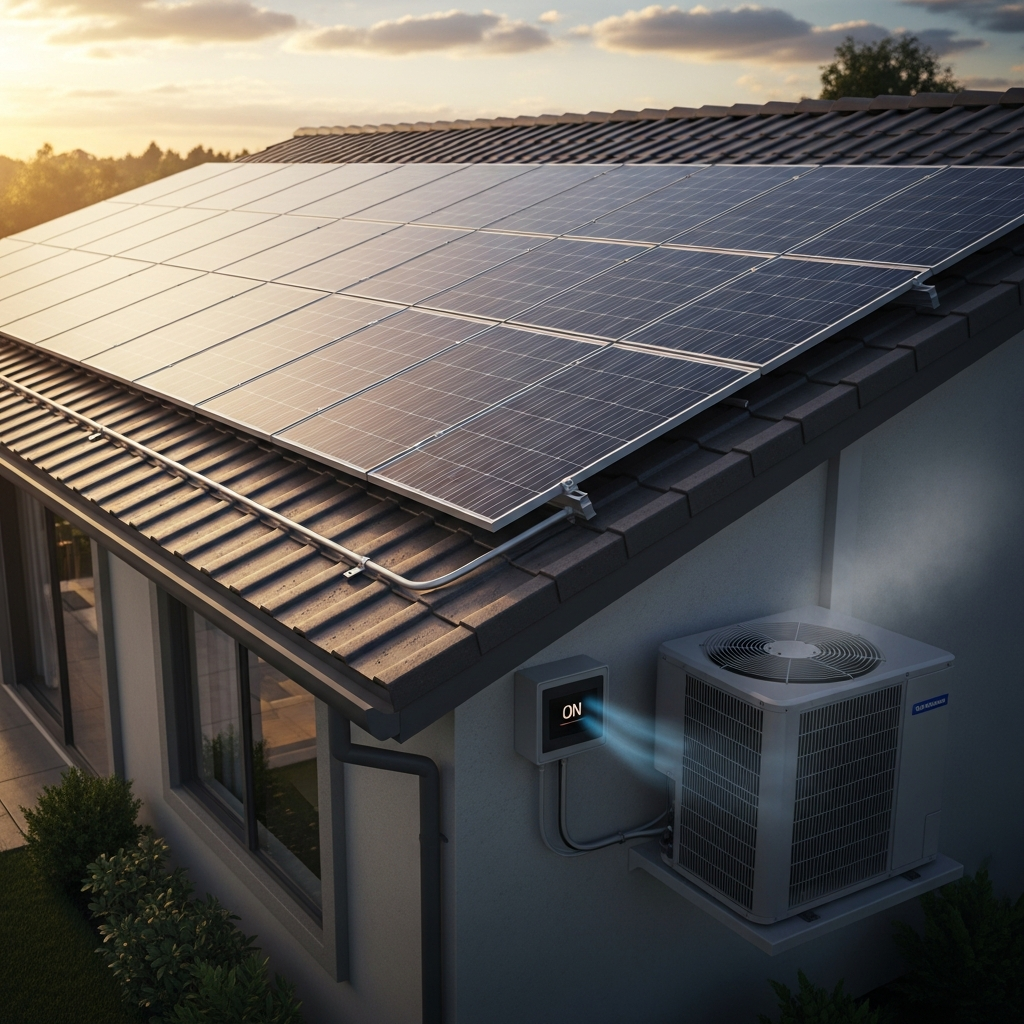
Running a 1.5 ton AC on solar power is achievable with the right setup. A standard 1.5 ton air conditioner requires approximately 1.5 to 2.0 kW of power. To meet this demand, you'll typically need a 2-3 kW solar panel system, which consists of about 6 to 9 panels, depending on their wattage.
- Section 1: Demystifying the Math – Can Solar Actually Handle a 1.5-Ton AC?
- Section 2: Sizing Your Solar System – The "3kW Rule" for Indian Homes
- Section 3: Top 3 Solar System Packages for a 1.5-Ton AC
- Section 4: The Financial Blueprint – Costs, ROI, and Government Subsidies
- Section 5: Roof Space, Installation, and Long-Term Maintenance
- Conclusion: Powering Your Cool Comfort with the Sun
- Frequently Asked Questions (FAQ)
Key Takeaways: 1. Yes, a 1.5-ton AC can run on solar, and the magic number for most Indian homes is a 3-kilowatt (kW) solar system. 2. The best system for you depends on your location: On-Grid systems are perfect for cities with stable power (to save on bills), while Off-Grid systems with batteries are essential for areas with frequent power cuts. 3. The upfront cost is significantly reduced by the PM Surya Ghar Yojana, which offers a direct subsidy of approximately ₹78,000 for a 3kW system, bringing the payback period down to just 3-5 years.
Section 1: Demystifying the Math – Can Solar Actually Handle a 1.5-Ton AC?
The short answer is: Yes, absolutely. Running a 1.5-ton air conditioner on solar power is not just possible; it's one of the smartest financial decisions an Indian homeowner can make to combat soaring summer electricity bills.
However, it's not as simple as just buying solar panels. It requires a correctly sized system that matches your AC's specific power needs.
Understanding Your 1.5-Ton AC’s True Power Draw
Not all ACs are created equal. The most crucial factor for a solar setup is whether your AC is an Inverter or Non-Inverter model.
- Inverter vs. Non-Inverter ACs: An Inverter AC (like modern 5-star models from Buy Daikin, Buy Voltas, or Buy LG) is highly recommended for solar. Its compressor runs at variable speeds, meaning it starts gently and then sips power, avoiding the massive initial power surge of older, non-inverter models.
- Wattage Breakdown: A typical 1.5-ton inverter AC consumes between 1,000 to 1,500 watts (1 to 1.5 kW) while running.
- Unit Consumption: In Indian electricity terms, this translates directly to "Units". Running your AC for 8 hours overnight will consume roughly 8 to 12 Units (kWh) of electricity from your meter. This is the daily consumption figure we need to eliminate.
The "Sunlight Hours" Reality in India
Your solar panels don't generate power 24/7. They only produce their peak rated power for about 4-5 hours per day, typically between 10 AM and 3 PM, when the sun is at its strongest.
This creates two distinct scenarios: running your AC during the day, which can be powered directly by the panels, and running it at night, which requires a way to store that daytime energy (using batteries) or "bank" it with the grid (using net metering).
Section 2: Sizing Your Solar System – The "3kW Rule" for Indian Homes
To reliably power a 1.5-ton AC and other essential household loads, you need a system that generates more energy than you consume daily. This is where the "3kW Rule" comes in.
Why a 3kW System is the Magic Number
A standard 3kW solar system in most parts of India will generate approximately 12 to 15 Units of electricity per day.
This perfectly offsets the 8-12 Units your AC consumes, leaving a comfortable buffer of 3-4 Units to run your fans, lights, refrigerator, and TV. It’s the ideal capacity to make your home self-sufficient for its primary loads.
Choosing the Right System Architecture (Crucial for ACs)
The type of solar system you choose is critical and depends entirely on the reliability of your local power grid.
- On-Grid Systems (The Bill Saver):
- Pros: Lower cost, no battery maintenance, highly efficient. It uses Net Metering to export your excess solar power to the grid during the day and imports power at night. Your bill is only for the "net" difference, which is often zero or even negative.
- Cons: It completely shuts down during a power cut for safety reasons. You will have no power.
- Best For: Homes in metro cities (Delhi, Mumbai, Bangalore, Chennai) with rare power cuts.
- Off-Grid Systems (The Power Cut Solution):
- Pros: Complete energy independence. It stores daytime solar energy in large batteries to power your home, including your AC, through the night and during power cuts.
- Cons: Higher cost due to batteries, requires battery maintenance (for lead-acid models), and some energy is lost during battery charging/discharging.
- Best For: Homes in Tier 2/3 cities, towns, or rural areas that experience regular load shedding.
- Hybrid Systems (The Best of Both):
- Pros: Combines the bill-saving benefits of an on-grid system with the power backup of an off-grid system. You get maximum reliability and savings.
- Cons: The highest upfront cost of all three types.
- Best For: Those who want a no-compromise solution and are willing to invest for total peace of mind.
The Role of the Solar Inverter
The solar inverter is the brain of your system. For a 1.5-ton AC, the inverter's capacity is more important than the panel's capacity. Even though you have a 3kW panel system, you must install a solar inverter with a capacity of at least 3.5kVA to 5kVA.
This oversizing is essential to handle the AC's "starting surge" or "jerk load"—the brief moment it draws 2-3 times its normal power to kickstart the compressor. A smaller inverter would trip and fail to start the AC.
Section 3: Top 3 Solar System Packages for a 1.5-Ton AC
Buying a solar system isn't about panels alone; it's about a complete, balanced ecosystem of panels, an inverter, and optional batteries. Here are the top packages trusted by homeowners across India, ranging from budget-friendly to premium. For a deeper dive into brands, you can read our guide on the best solar brands in India: Tata vs. Luminous.
| Rank | Product Name | Best For | Link |
|---|---|---|---|
| 1 | Tata Power Solar 3kW On-Grid System | Metro/City Homes (Bill Reduction) | Buy on Amazon |
| 2 | Luminous 3kW Off-Grid Solar Combo | Areas with Power Cuts (Backup) | Buy on Amazon |
| 3 | Loom Solar 3kW Hybrid w/ Lithium | Premium/Space-Saving (Future-Proof) | Buy on Amazon |
Top Pick 1: Tata Power Solar 3kW On-Grid System (Best for Metro/City Homes)
- Components: High-efficiency Monocrystalline PERC panels, Buy Tata Grid-Tie Inverter.
- Pros: Tier-1 brand with immense trust, a 25-year performance warranty, and excellent support for seamless net-metering approval. Their panels are highly efficient even in cloudy or monsoon conditions.
- Cons: Provides zero backup during a power cut.
- Ideal For: Homeowners in big cities whose primary goal is to make their summer electricity bills ₹0.
Top Pick 2: Luminous 3kW Off-Grid Solar Combo (Best for Areas with Power Cuts)
- Components: Buy Luminous Solar Panels, Solarverter Pro (PCU), 4 x 150Ah Solar Tubular Batteries.
- Pros: A workhorse system designed for Indian conditions. It provides robust battery backup to run your AC for 4-6 hours at night, and Luminous has an unparalleled after-sales service network across the country.
- Cons: Traditional lead-acid batteries require periodic distilled water topping and take up significant floor space.
- Ideal For: Homes in towns and cities suffering from 2 or more hours of daily load shedding.
Top Pick 3: Loom Solar 3kW Hybrid Setup with Lithium-Ion (Best Premium/Space-Saving)
- Components: Buy Loom Solar SHARK 550W Bi-facial panels, Fusion Hybrid Inverter, Buy CAML Lithium-ion battery.
- Pros: This is cutting-edge technology. Bi-facial panels generate power from both sides, taking up 30% less roof space. The lithium battery requires zero maintenance, has a 3x longer life than lead-acid batteries, and is very compact. Confused about batteries? Our guide on LiFePO4 vs. Lead-Acid solar batteries breaks it down.
- Cons: This is the most expensive option upfront.
- Ideal For: Homeowners with limited roof space (like independent floors in a builder apartment) who want the absolute best, maintenance-free technology available today.
Section 4: The Financial Blueprint – Costs, ROI, and Government Subsidies
The biggest question for any Indian family is, "How much will it cost?" While the upfront investment is significant, government subsidies and long-term savings make it extremely profitable.
Estimated Upfront Costs (3kW System)
- On-Grid System: ₹1,50,000 – ₹1,80,000
- Off-Grid System (with Lead-Acid Batteries): ₹2,00,000 – ₹2,40,000
- Hybrid System (with Lithium-Ion): ₹2,80,000 – ₹3,50,000
Leveraging the PM Surya Ghar: Muft Bijli Yojana
The central government's new scheme makes solar more affordable than ever. For a residential 3kW system, you are eligible for a direct subsidy that significantly lowers your initial cost.
- The current subsidy for a 3kW system is ₹78,000.
- This amount is transferred directly to your bank account after the system is installed and inspected.
- Crucial Note: Subsidies are generally applicable only for On-Grid (grid-connected) systems and often require the use of domestically manufactured (DCR) panels.
Calculating the Return on Investment (ROI)
Let's do the math for a subsidized on-grid system: * Initial Cost: ₹1,60,000 * Less Subsidy: - ₹78,000 * Final Cost to You: ₹82,000
With an average monthly savings on your electricity bill of ₹3,000 to ₹5,000 during summer months, your system pays for itself. * Payback Period: Your investment of ₹82,000 is recovered in just 3.5 to 5 years. After that, you enjoy over 20 years of free electricity to run your AC.
For financing, major banks like SBI, HDFC, and various NBFCs offer dedicated low-interest solar loans to make the upfront payment manageable.
Section 5: Roof Space, Installation, and Long-Term Maintenance
Getting the physical installation right is just as important as choosing the right components.
Roof Space Requirements
- A standard 3kW system, using about 6-7 panels, requires approximately 300 sq. ft. of shadow-free roof space.
- To keep your terrace usable for other activities like drying clothes or evening walks, ask your installer to mount the panels on an elevated structure (pergola style).
Direction and Shadowing (The Indian Context)
- Direction is Non-Negotiable: To capture the maximum sunlight throughout the day in India, your solar panels must face South.
- Beware the Water Tank Shadow: A common mistake is ignoring shadows cast by water tanks, stairwell rooms, or neighboring buildings. Even a small, consistent shadow on one part of your panel array can reduce the entire system's efficiency by over 30%.
Maintenance & Upkeep (Dealing with Indian Dust)
Your solar panels are like a car's windshield—if they're dirty, they can't perform. Dust is the #1 enemy of solar generation in India.
- It is essential to clean your panels once every 15 days, especially in dusty regions of North India or near construction sites.
- You can do this with a long-handled mop and plain water in the early morning or late evening. For more tips, check our detailed guide on solar panel maintenance tips.
Final Checklist Before You Buy
Before you sign the cheque, ensure your installer's quote includes these non-negotiable safety items: 1. Proper Earthing: Ask for details on the chemical earthing being provided for the system's safety. 2. Lightning Arrester (LA): This is a small device that protects your expensive solar system from lightning strikes during monsoons. 3. DISCOM Empanelment: If you're applying for a subsidy or net metering, verify that your chosen installation company is officially empanelled with your local electricity distribution company (e.g., BSES, TPDDL, UPPCL).
Of course. Here is a strong conclusion and a 3-question FAQ for an article on running a 1.5 ton AC with solar panels, including the critical JSON-LD schema.
Conclusion: Powering Your Cool Comfort with the Sun
In conclusion, the question isn't if solar panels can run a 1.5 ton AC, but rather how to design the right system to do it effectively. The answer is a definitive yes. Powering this high-demand appliance requires a dedicated solar setup—typically ranging from 2 to 3 kilowatts—paired with a capable inverter to handle the AC's significant startup load.
While running your air conditioner directly from the sun during peak daylight hours is a straightforward goal, achieving true energy independence requires more. To power your AC through cloudy days, at night, or during a grid outage, a battery storage system becomes an essential component, transforming your setup from a grid-dependent supplement into a resilient, self-sufficient power source.
Ultimately, running your air conditioner on solar power is a powerful and achievable step towards reducing your carbon footprint and slashing your electricity bills. It is a strategic investment in a sustainable and comfortable future that, with proper planning and professional guidance, is entirely within reach.
Frequently Asked Questions (FAQ)
How many solar panels are needed for a 1.5 ton AC?
For a typical 1.5 ton air conditioner (which consumes about 1.8-2.0 kW), you will generally need a 2.5 to 3 kW solar panel system. This translates to roughly 6 to 10 solar panels, depending on the wattage of the panels (e.g., 350W vs. 500W) and your geographic location's average sunlight. This capacity ensures enough power is generated to run the AC and handle its initial surge current.
Do I need batteries to run my AC on solar?
It depends on your goal. If you only want to run the AC during peak sunny hours to reduce your daytime electricity bill (a grid-tied system), you may not need batteries. However, if you want to run your AC at night, on overcast days, or during a power outage (an off-grid or hybrid system), then a battery bank is absolutely essential to store the excess energy generated during the day.
Can I run my existing 1.5 ton AC with solar, or do I need a special one?
Yes, you can absolutely run your existing 1.5 ton AC with a properly sized solar power system. You do not need a special "solar AC." The system's inverter converts the DC power from the panels and batteries into the standard AC power your appliance uses. However, modern, energy-efficient inverter-type ACs are highly recommended as they consume less power and have a softer startup, which can reduce the overall size and cost of the solar system you need.