On-Grid vs Off-Grid Solar in India: Which is Best?
Deciding between on-grid and off-grid solar in India depends on your energy needs and location. On-grid systems offer lower costs and government subsidies through net metering, while off-grid systems provide reliable battery backup for areas with frequent power cuts. Find out which is right for you.
- Ultimate Guide: On-Grid vs. Off-Grid Solar for Indian Homeowners
- Section 1: The Solar Revolution in India – Understanding Your Fundamentals
- Section 2: Deep Dive into On-Grid Solar Systems
- Section 3: Deep Dive into Off-Grid Solar Systems
- Section 4: The Showdown & Top 3 Product Comparison
- Section 5: The Homeowner’s Action Plan (Next Steps)
- Conclusion
- Frequently Asked Questions (FAQ)
Key Takeaways: * On-grid systems are the cheapest and fastest way to reduce your electricity bill to zero, offering excellent government subsidies but no backup during power cuts. * Off-grid systems provide total energy independence and protect you from load shedding, but they require expensive batteries and do not qualify for major government rooftop subsidies. * The PM Surya Ghar: Muft Bijli Yojana has made solar highly affordable, offering up to ₹78,000 in direct subsidies for a standard 3kW household system.
Ultimate Guide: On-Grid vs. Off-Grid Solar for Indian Homeowners
Section 1: The Solar Revolution in India – Understanding Your Fundamentals
1.1 The Current Indian Solar Landscape
Indian homeowners are facing a massive squeeze as DISCOM tariffs continue to rise by 5% to 10% annually across major states. Running air conditioners during the brutal Indian summer now results in crippling electricity bills that eat directly into household budgets. Fortunately, shifting to rooftop solar is no longer a luxury reserved for the ultra-rich.
The true game-changer has been the launch of the PM Surya Ghar: Muft Bijli Yojana. This flagship government initiative makes solar highly accessible for the middle class by providing massive direct subsidies. With a simple online application, an average Indian family can now generate free electricity for the next 25 years.
1.2 Decoding the Terminology: What Are You Buying?
Before calling a vendor, you must understand the basic technologies available in the market.
- On-Grid (Grid-Tied): Known as the "Bill Reducer." This system connects directly to your local electricity grid and does not require batteries.
- Off-Grid (Standalone): Known as the "Power Cut Savior." This setup relies entirely on a heavy-duty battery bank and is completely disconnected from the neighborhood grid.
- Hybrid: The "Best of Both Worlds." This premium setup connects to the grid to earn you credits, but also includes a battery backup to keep your lights on during blackouts.
1.3 The 3 Golden Questions for Homeowners
To choose the right system, you need to answer three critical questions about your household.
First, how many power cuts do you experience daily or weekly? If power cuts are rare, on-grid is your best bet; if they are frequent, you need off-grid or hybrid.
Second, what is your primary goal: Zero electricity bills or uninterrupted power? Finally, what is your upfront budget, and do you want to rely on government subsidies to lower the cost?
Section 2: Deep Dive into On-Grid Solar Systems
2.1 How On-Grid Works in the Indian Context
An on-grid system operates seamlessly in the background without any manual intervention. The mechanics are simple: Solar Panels generate DC power, which the Solar Inverter converts into AC power for your home appliances. Any excess power you generate is pushed out to the neighborhood grid through a Bi-directional Meter.
This introduces the magic of Net Metering. When you export excess power during the sunny daytime, your DISCOM credits your account. At night, you pull electricity from the grid, and those daytime credits neutralize your nighttime usage, effectively resulting in a ₹0 electricity bill.
2.2 The Financials: Subsidies and ROI
Applying for subsidies is now completely digitized through the National Portal for Rooftop Solar. Under the current PM Surya Ghar scheme, the financial backing for on-grid systems is unprecedented.
The government pays a substantial subsidy: ₹30,000 for a 1kW system, ₹60,000 for a 2kW system, and a capped maximum of ₹78,000 for systems 3kW and above. Because of these aggressive subsidies, the average payback period for an Indian home is now remarkably short, typically hovering between 3 to 5 years.
2.3 The Pros and Cons for the Indian Home
Before committing to an on-grid setup, weigh these critical advantages and limitations.
- Pros:
- Lowest upfront cost compared to other solar setups.
- Zero ongoing battery replacement costs.
- Highest ROI and fastest payback period.
- Eligible for the maximum government rooftop subsidies.
- Cons:
- Subject to the strict Anti-Islanding Rule. This safety mandate requires your on-grid inverter to shut down immediately during a neighborhood power cut so that grid repair workers aren't electrocuted by your panels.
- It will not solve load-shedding issues or provide emergency backup.
- Best Suited For: Homeowners in Tier 1 cities and urban areas with stable electricity and very rare power cuts (e.g., Mumbai, Delhi, Bengaluru).
Section 3: Deep Dive into Off-Grid Solar Systems
3.1 How Off-Grid Works: Your Personal Power Plant
An off-grid system turns your home into a completely independent energy fortress. The energy flows from your Solar Panels to a Charge Controller, which safely stores the power in a massive Battery Bank. From there, your Off-Grid Inverter pulls the stored power to run your household appliances.
Because you have no grid to fall back on, accurately sizing the system is absolutely critical to prevent system failure. You must calculate your exact "Peak Load" by adding up the wattage of all ACs, fridges, and heavy motors you plan to run simultaneously. For rural areas running heavy inductive loads, you might also want to explore a dedicated solar pump for agriculture in india rather than running them off your home inverter.
3.2 The Battery Dilemma in India
The success of your off-grid system entirely depends on the batteries you choose to install.
Tall Tubular Lead-Acid Batteries are the traditional choice popularized by massive Indian inverter brands. They are cheaper upfront, but they are heavy, require frequent water top-ups, and have a limited lifespan of 3-5 years.
Alternatively, Lithium-ion (LiFePO4) Batteries are the modern standard. While they are expensive upfront, they are compact, require zero maintenance, and boast a massive lifespan of 10+ years. If you are torn between these choices, you must read our deep dive on lifepo4 vs lead acid solar battery and check out our comprehensive solar battery comparison to make the right investment.
3.3 The Pros and Cons for the Indian Home
Off-grid systems are lifesavers in challenging environments, but they come with distinct trade-offs.
- Pros:
- 100% immunity from load shedding and local grid failures.
- True energy independence, shielding you from rising DISCOM tariffs forever.
- Cons:
- Requires an upfront investment that is 40% to 60% more expensive than on-grid setups.
- Batteries will eventually degrade and require costly replacements.
- Not eligible for major government rooftop subsidies.
- Requires significantly more monitoring and maintenance.
- Best Suited For: Homes in Tier 2/3 cities, remote rural areas, sprawling farmhouses, or neighborhoods suffering from 2+ hours of daily power cuts.
Section 4: The Showdown & Top 3 Product Comparison
4.1 The Ultimate Showdown Matrix
Use this quick reference table to compare the two dominant systems across the five most important pillars of solar ownership.
| Feature | On-Grid Solar | Off-Grid Solar |
|---|---|---|
| Upfront Cost | Lowest (Approx ₹50k-₹60k per kW) | Highest (Approx ₹80k-₹1L+ per kW) |
| Subsidy Eligibility | High (Up to ₹78,000) | None (Generally not subsidized) |
| Power Cut Backup | Zero (Shuts down for safety) | 100% Seamless Battery Backup |
| Maintenance | Very Low (Occasional panel cleaning) | High (Battery maintenance & monitoring) |
| ROI Speed | Fast (3 to 5 years) | Slow (7 to 10 years) |
4.2 Top 3 Product Comparison
Note: Inverters are the absolute "brain" of your solar system. Choosing a highly reputable brand directly dictates the lifespan and safety of your entire setup.
| Rank | Product Name | Best For | Link |
|---|---|---|---|
| 1 | Tata Power Solar System | Urban Zero-Bill Subsidized Setup | Buy Tata Power Solar |
| 2 | Luminous Solar NXG Inverter | Frequent Power Cuts & Heavy Loads | Buy Luminous Solar NXG |
| 3 | Enphase Microinverters | Premium Hybrid / Luxury Villas | Buy Enphase Microinverter |
1. The On-Grid Champion: Tata Power Solar When it comes to grid-tied setups, the Tata Power Solar System dominates the Indian market. It features Tier-1 high-efficiency panels paired with ultra-reliable grid-tie inverters.
It ranks at the top because of its unmatched brand trust, end-to-end installation service, and a massive 25-year performance warranty. Most importantly, Tata's localized vendors make the notoriously complex process of claiming government subsidies and getting DISCOM net-metering approvals incredibly streamlined. Buy Tata Power Solar System.
2. The Off-Grid Workhorse: Luminous Solar NXG / Solarverter For off-grid homes, the Luminous Solar NXG line is an absolute beast. It features advanced MPPT technology that squeezes maximum juice from your panels, integrating seamlessly with Luminous Tall Tubular solar batteries.
It ranks highly because its rugged internal build is specifically designed to handle extreme Indian summer heat and wild village voltage fluctuations. Furthermore, Luminous has a massive nationwide service network, meaning you can get rapid repairs even in remote Tier-3 towns. Buy Luminous Solar NXG Inverter.
3. The Premium Hybrid Option: Waaree Panels + Enphase Energy If budget is not an issue, pairing high-efficiency Waaree Panels with Enphase Microinverters creates the ultimate smart home system. Instead of one central inverter, each panel gets its own microinverter, solving the dilemma by allowing both grid-export and seamless battery backup integration.
This setup ranks as the premium choice because it boasts the safest technology available (eliminating dangerous high-voltage DC on your roof) and provides granular smartphone-level monitoring. It is strictly ideal for luxury villas willing to pay a premium for cutting-edge, future-proof energy. Buy Enphase Microinverter and Buy Waaree Solar Panels.
Section 5: The Homeowner’s Action Plan (Next Steps)
5.1 The 4-Step Decision Tree
Stop overthinking and follow this simple, actionable process. * Step 1: Track your daily power cuts. If they are less than 30 minutes, go On-grid; if they exceed 2 hours, you must choose Off-grid or Hybrid. * Step 2: Measure your roof capacity. You need roughly 100 sq. ft. of shadow-free space per 1kW of solar capacity. * Step 3: Check the "Sanctioned Load" printed on your latest electricity bill, as DISCOMs usually restrict your solar system size to this limit. * Step 4: Secure your financing, noting that major Indian banks now offer specific low-interest loans for solar rooftops.
5.2 How to Hire the Right EPC Vendor in India
Finding the right Engineering, Procurement, and Construction (EPC) vendor is more important than picking the panel brand. You must absolutely ensure that your vendor is strictly MNRE empanelled; otherwise, your application for government subsidies will be flatly rejected.
When interviewing vendors, always ask crucial operational questions. Ask them directly: "Do you handle the complete net-metering liaison and paperwork with the local DISCOM?" If they say no, walk away immediately, as navigating the state electricity board on your own is a nightmare.
5.3 Conclusion
Transitioning to solar is not just an environmental choice; it is one of the smartest financial investments you can make for your household. Installing a robust system instantly increases the property value of your home while completely insulating your family from relentless power inflation for the next quarter-century.
Take the first step toward a zero-rupee electricity bill today. We highly recommend downloading the official PM Surya Ghar app or using an online solar calculator to estimate your exact savings based on your monthly consumption!
Conclusion
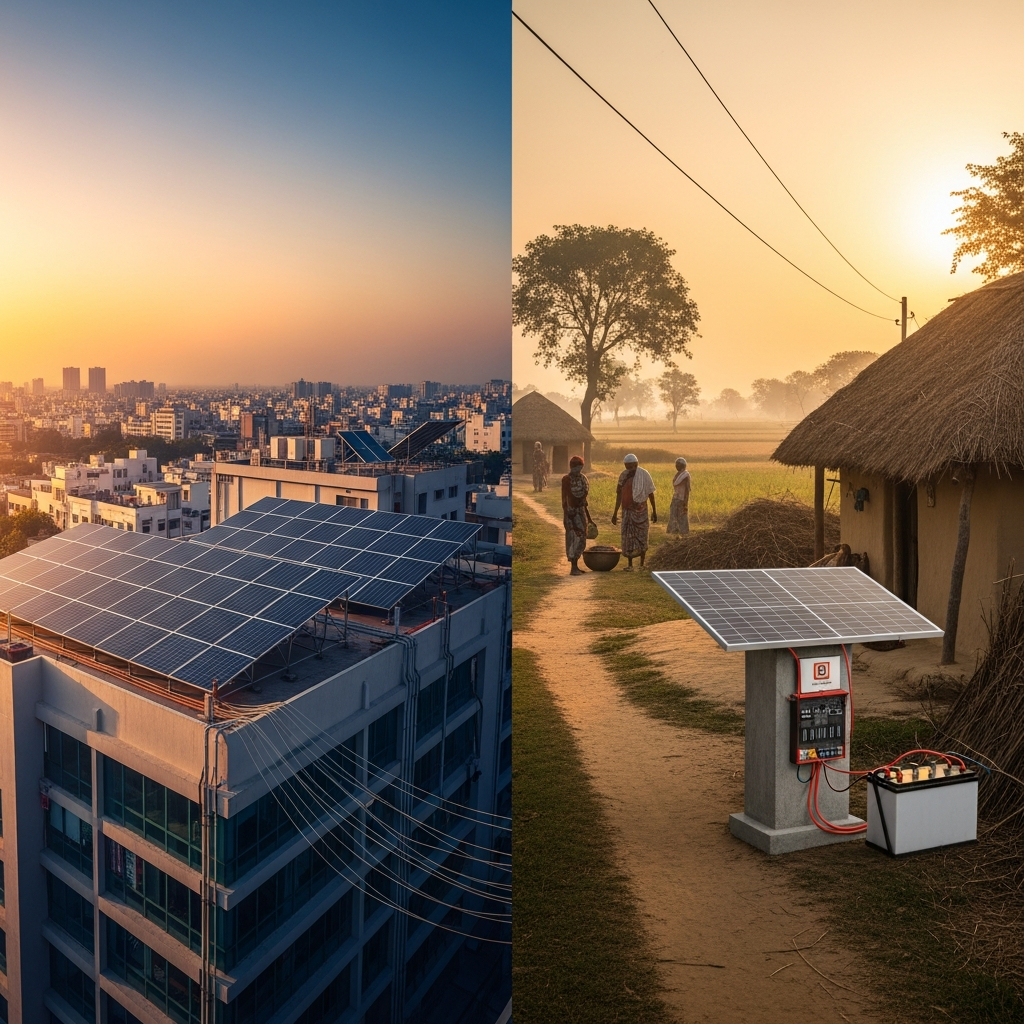
In India, choosing between an on-grid and off-grid solar system ultimately boils down to your location, budget, and power reliability needs. If you live in a city or state with relatively stable electricity and want to maximize your financial savings through net metering, an on-grid system is the most cost-effective and practical choice. It also allows you to take full advantage of lucrative government subsidies like the PM Surya Ghar Muft Bijli Yojana.
However, if you reside in a remote area facing frequent, prolonged power cuts—or if you simply desire total energy independence without relying on the local DISCOM—an off-grid system equipped with a robust battery bank is your best bet. By carefully assessing your daily energy consumption and consulting with certified local solar installers, you can make an informed decision that brightens your home and drastically lowers your electricity bills for decades to come.
Frequently Asked Questions (FAQ)
Which is cheaper: on-grid or off-grid solar in India?
On-grid solar systems are significantly cheaper. Because they do not require expensive solar batteries for energy storage, the upfront cost and maintenance expenses are much lower compared to off-grid systems. Furthermore, on-grid systems are eligible for central and state government subsidies, making them highly economical for standard Indian households.
Can I run my AC on an off-grid solar system?
Yes, you can run an air conditioner on an off-grid solar system, but it requires careful sizing. You will need a high-capacity solar inverter and a substantial battery bank to handle the heavy starting load and continuous power draw of an AC unit. Keep in mind that scaling up your system to support heavy appliances will significantly increase the overall cost of your off-grid setup.
What happens to an on-grid solar system during a power cut?
During a power cut, an on-grid solar system automatically shuts down and stops producing usable electricity for your home. This is a mandatory safety mechanism known as "anti-islanding," which prevents your system from sending electricity back into the grid and potentially electrocuting utility workers who are repairing the power lines. If your area experiences frequent power cuts, a hybrid solar system (which combines grid connection with battery backup) might be a better alternative.