LiFePO4 vs Lead Acid: Best Solar Battery Guide
Choosing between LiFePO4 and lead acid solar batteries can make or break your off-grid system. While lead acid offers lower upfront costs, LiFePO4 provides superior lifespan, deeper discharge rates, and zero maintenance. Read our comprehensive guide to find the perfect solar battery for your needs.
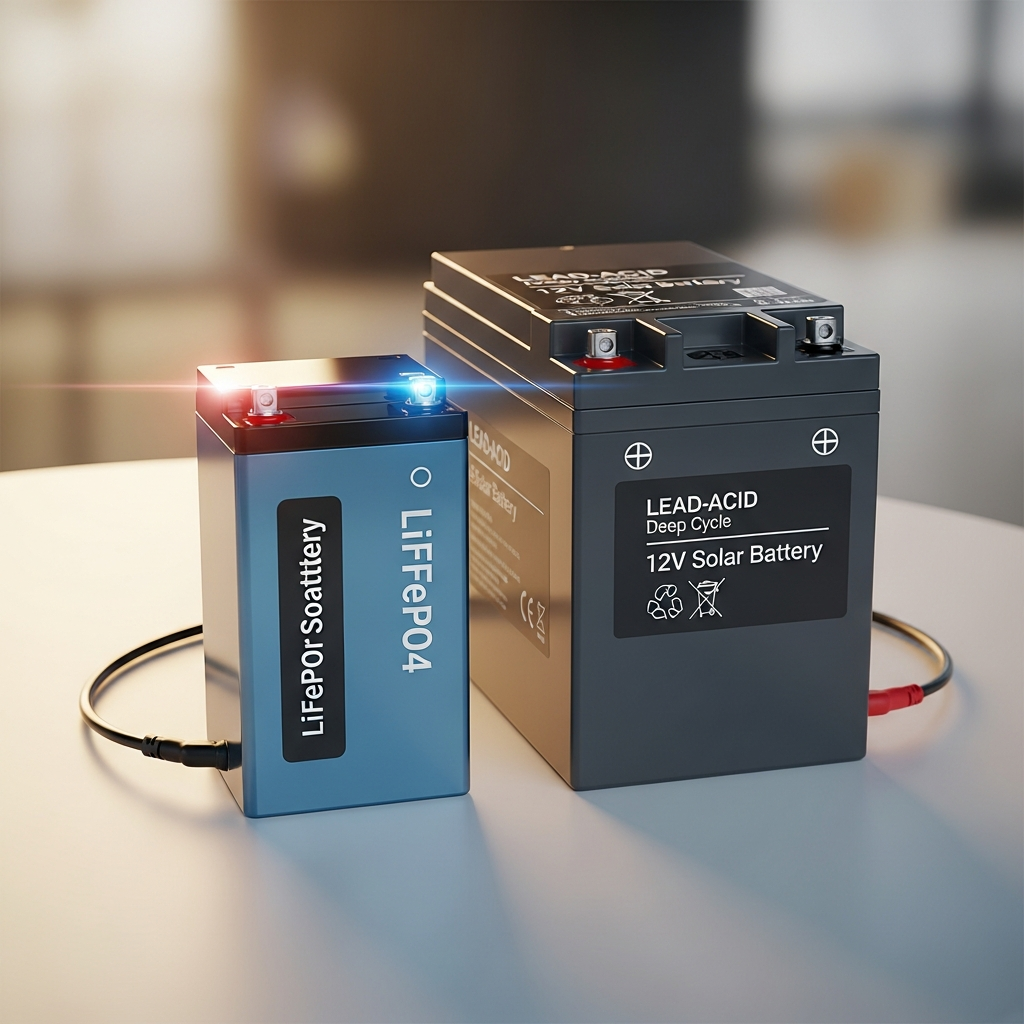
The Ultimate Solar Battery Showdown: LiFePO4 vs. Lead-Acid for Indian Homes
Target Audience: Indian homeowners looking to install a new rooftop solar system or upgrade their existing home inverter battery setup.
Section 1: Introduction – Powering the Modern Indian Home
1.1 The Rooftop Solar Revolution in India
India is currently undergoing a massive energy transition. With grid electricity tariffs steadily rising—costing anywhere from ₹6 to ₹10+ per unit depending on your state—and the push for energy independence through initiatives like the PM Surya Ghar Muft Bijli Yojana, more homeowners than ever are turning to rooftop solar. However, whether you are dealing with frequent summer power cuts or aiming for a zero-electricity bill, the solar panels are only half the equation. The battery is the true "heart" of an off-grid or hybrid solar system, determining how reliably your home runs when the sun goes down.
1.2 Meet the Contenders (A Brief Overview)
When selecting a solar battery, Indian consumers are primarily faced with two distinct technologies: * Lead-Acid (The Veteran): Ranging from flat-plate to tall tubular batteries (specifically C10 ratings for solar), this is the traditional standard that has powered Indian homes for decades. Brands like Exide and Luminous have made these household names. * LiFePO4 / Lithium Iron Phosphate (The Modern Marvel): This represents the safest, most durable tier of lithium-ion technology. Thanks to its longevity and compact size, LiFePO4 is rapidly replacing older battery technologies across the globe.
1.3 The Big Question
For years, the heavy, acid-filled tubular battery was the default choice. But today, Indian homeowners are suddenly shifting away from traditional batteries. The big question is: does the high upfront cost of a Lithium (LiFePO4) battery actually make financial sense for a middle-class Indian home? To answer that, we must look beyond the MRP and dive into the technical and financial realities of both.
Section 2: Head-to-Head Technical Comparison (The Indian Context)
2.1 Depth of Discharge (DoD) & Usable Capacity
Depth of Discharge (DoD) is a simple concept: it tells you how much of the battery's stored juice you can actually use without damaging it. * Lead-Acid (50% DoD): A standard 150Ah tubular battery only gives you about 75Ah of usable power. If you drain it completely, you will permanently damage its internal plates. * LiFePO4 (90-100% DoD): A 100Ah LiFePO4 battery allows you to safely use nearly the entire 100Ah. In short, with lithium, you actually get the full capacity you pay for.
2.2 Lifespan and Cycle Life
A "cycle" is one full charge and discharge of a battery. Just as understanding solar panel degradation rates is crucial for estimating your panel's lifespan, cycle life dictates your battery's longevity. * Lead-Acid: Typically rated for 300 to 800 cycles. In the harsh conditions of an Indian home, this translates to a lifespan of 3 to 5 years before it requires replacement. * LiFePO4: Rated for a massive 3,000 to 6,000+ cycles. Even with daily heavy use, a LiFePO4 battery can easily last 10 to 15+ years.
2.3 Charging Speed & Solar Efficiency
During the Indian monsoon or foggy North Indian winters, sunlight is limited. Furthermore, during rolling power cuts, your battery needs to charge as quickly as possible when grid power returns. * Lead-Acid: Charges slowly due to a mandatory "absorption phase." Pushing too much current into it causes overheating and acid boiling. * LiFePO4: Can accept high charge currents, charging up to 4x faster than tubular batteries. It captures intermittent solar energy far more efficiently.
2.4 Size, Weight, and Space Constraints
Urban Indian apartments often suffer from space constraints, relegating inverters to small utility areas or balconies. * Lead-Acid: These are incredibly heavy (a 150Ah battery can weigh over 50kg), take up significant floor space, and emit corrosive, acidic fumes that require well-ventilated spaces. * LiFePO4: Around 70% lighter and astonishingly compact. They can be safely wall-mounted indoors, even next to your TV or inside a bedroom, as they emit zero fumes.
2.5 Temperature Tolerance (The Indian Summer Test)
Indian summers frequently push indoor temperatures to 40°C - 50°C in North and Central India. * Lead-Acid: Extreme heat causes the internal water to evaporate quickly and degrades the lead plates rapidly, slashing the battery's lifespan. * LiFePO4: High-quality LiFePO4 batteries come with active cooling designs and high thermal stability, allowing them to handle the brutal Indian summer with minimal capacity loss.
Section 3: Financial Analysis – The "Kitna Deti Hai?" (ROI) Factor
3.1 The Upfront Cost Illusion
At first glance, Lead-Acid looks like a bargain. A 5kWh Lead-Acid battery bank might cost around ₹30,000 to ₹40,000, while a 5kWh LiFePO4 setup commands a premium of ₹1,00,000 to ₹1,30,000. However, comparing them Ah-for-Ah is a fundamental mistake. Because of the DoD differences mentioned earlier, a 100Ah LiFePO4 battery does the work of two 100Ah Lead-Acid batteries.
3.2 Maintenance and Hidden Costs
- Lead-Acid: You must routinely check water levels, buy distilled water, and occasionally call a technician. While reviewing our solar panel maintenance tips will keep your panels shining, dealing with acid spills, corroded battery terminals, and ruined floor tiles is an ongoing, hidden cost of tubular batteries.
- LiFePO4: This is a true "Install and Forget" technology. Zero water topping. Zero terminal corrosion. Zero maintenance costs.
3.3 The 10-Year Total Cost of Ownership (TCO) Calculation
Let’s look at a scenario running a 3kW house load over 10 years: * Lead-Acid Route: You spend ₹35,000 upfront. By year 4, you replace the batteries (₹38,000 with inflation). By year 8, you replace them again (₹42,000). Total cost: ₹1,15,000+ (excluding distilled water and technician visits). * LiFePO4 Route: You spend ₹1,00,000 upfront. Over 10 years, you require ZERO replacements and ZERO maintenance. * The Verdict: Despite the initial price shock, LiFePO4 actually saves you ₹15,000 to ₹30,000+ over a decade, while providing a vastly superior, hassle-free experience.
3.4 Warranties & Financing
Most standard tubular batteries offer a 3 to 5-year warranty (often pro-rata). In contrast, modern LiFePO4 batteries offer solid 5 to 10-year replacement warranties. With the easy availability of solar EMIs today, homeowners can finance the upfront cost of Lithium, aligning their monthly EMI with the savings on their electricity bill.
Top 3 Product Comparison
If you are ready to make a purchase, here are the top-rated options currently available in the Indian market across different categories:
- Best Budget Lead-Acid (For Rural/Open Spaces):
Luminous Red Charge 150Ah Tubular Battery
A highly reliable C10 rated traditional battery, perfect if upfront budget is your primary constraint. - Best 12V Lithium Drop-In Replacement:
Nexus 12V 100Ah LiFePO4 Solar Battery
A fantastic, compact lithium battery that can directly replace a standard 150Ah tubular battery while providing a 10-to-15 year lifespan. - Best All-In-One Modern Upgrade:
Luminous Li-ON 1250 Pure Sinewave Inverter with Built-in LiFePO4
An aesthetic, wall-mounted inverter with an integrated LiFePO4 battery. Ideal for premium apartments needing zero maintenance and zero noise.
Section 4: Making the Right Choice for Your Home
4.1 Profile A: The Budget-Conscious / Rural Setup
- Who it’s for: Homes in semi-urban or rural areas with plenty of floor space, highly ventilated utility areas, strict upfront budget limits, and easy access to local battery technicians.
- Recommendation: High-quality Tubular Lead-Acid (ensure it has a "C10" rating, which is specifically designed for solar charging).
4.2 Profile B: The Urban Villa / Premium Apartment
- Who it’s for: Space-constrained homes that run heavy appliances, desire a clean, wire-free aesthetic, and want absolute peace of mind with zero maintenance. Furthermore, if you are asking can solar panels run a 1.5 ton ac, a high-capacity LiFePO4 battery bank is practically mandatory to safely handle the high surge currents of heavy motors and compressors.
- Recommendation: Wall-mounted LiFePO4 rack systems.
4.3 Demystifying Safety Myths
A common fear among homeowners is: "Will a lithium battery catch fire in my house?" It is vital to understand the difference between lithium chemistries. The batteries in smartphones and electric vehicles that occasionally make the news for fires are usually NMC (Nickel Manganese Cobalt). LiFePO4 (Lithium Iron Phosphate), on the other hand, is highly stable, chemically non-combustible, and exceptionally safe. Even if punctured or subjected to extreme heat, LiFePO4 will not catch fire.
4.4 Translating Old Inverter Language to Modern Solar
Many local electricians still speak in "inverter language." If your electrician says, "Sir, you need a double-battery (24V) inverter setup," they mean two heavy 12V 150Ah tubular batteries. To upgrade this to modern solar, you do not need two separate lithium batteries. You simply buy a single 24V 100Ah LiFePO4 unit. It will provide the exact same usable backup, take up a quarter of the space, and weigh a fraction of the traditional setup.
Section 5: Installation, Upgrades & Future Outlook
5.1 Can I Use My Existing Inverter with a LiFePO4 Battery?
Many homeowners wonder if they need a new inverter to switch to Lithium. The answer lies in your existing inverter's charging profile. Older Lead-Acid inverters have an "equalization" and "absorption" charging phase designed to forcefully stir battery acid. If applied to a Lithium battery, this high-voltage phase can trigger the battery's protective shutdown or cause damage over time. Check if your existing inverter (from brands like Luminous, Microtek, or V-Guard) has a specific "Lithium/LiFePO4" switch or profile setting. If it doesn't, upgrading to a modern hybrid solar inverter is highly recommended.
5.2 The Role of the BMS (Battery Management System)
Every LiFePO4 battery comes with a built-in computer called the BMS. This acts as the brain of the battery, protecting the expensive lithium cells from overcharging, deep discharging, short circuits, and extreme temperatures. Today, smart BMS units come with Bluetooth connectivity, allowing tech-savvy Indian homeowners to monitor their exact battery percentage, health, and charging speed directly via a smartphone app.
5.3 Environmental Impact
Beyond personal convenience, there is a broader impact to consider. Lead-acid batteries contain highly toxic lead and sulfuric acid. While recycling networks exist in India, improper disposal remains a massive environmental hazard. LiFePO4 is entirely non-toxic, free of heavy metals like cobalt, and much kinder to the environment, making it the truly "green" choice for a solar-powered home.
5.4 Final Verdict & Actionable Next Steps
The Verdict: Buy Lead-Acid if you need a cheap, short-term fix and have space to spare. Invest in LiFePO4 for long-term peace of mind, superior performance, and ultimately, a better Return on Investment (ROI).
Homeowner Checklist: 1. Calculate Daily Power Usage: Determine your usable Ah requirements rather than relying blindly on old 150Ah tubular standards. 2. Check Inverter Compatibility: Ensure your current or proposed hybrid inverter supports a LiFePO4 charging profile. 3. Ask for TCO, Not MRP: When talking to local solar vendors, calculate the Total Cost of Ownership over 10 years to see the true value of your investment.
Conclusion: The Clear Winner for Solar Storage
When settling the debate between LiFePO4 and lead-acid solar batteries, the final verdict comes down to long-term value versus upfront cost.
While traditional lead-acid batteries remain a viable, budget-friendly option for weekend RV trips or small, occasional-use off-grid cabins, they simply cannot compete with the modern performance of lithium. LiFePO4 (Lithium Iron Phosphate) is the undisputed champion for serious solar energy systems.
By offering up to ten times the lifespan, 100% usable capacity (depth of discharge), zero maintenance, and superior safety, LiFePO4 batteries deliver a significantly higher return on investment. Even though the initial purchase price is higher, the cost-per-cycle of a LiFePO4 battery is drastically lower than that of a lead-acid battery. If you want a reliable, "set-it-and-forget-it" solar storage solution that will power your home or RV for the next decade, upgrading to LiFePO4 is the smartest investment you can make.
Frequently Asked Questions (FAQ)
1. Can I easily replace my lead-acid solar battery with a LiFePO4 battery? Yes, in most cases, upgrading from lead-acid to LiFePO4 is a straightforward process. Many LiFePO4 batteries are designed as "drop-in" replacements. However, because lithium and lead-acid batteries have different charging profiles, you must ensure that your existing solar charge controller and inverter have a dedicated lithium setting or allow for custom programmable voltage parameters.
2. Which battery is more cost-effective in the long run, LiFePO4 or lead-acid? LiFePO4 is vastly more cost-effective in the long run. While a lead-acid battery is cheaper to buy upfront, it typically lasts only 300 to 500 cycles and can only be discharged to 50% without causing damage. A LiFePO4 battery lasts between 3,000 and 5,000+ cycles and can be discharged deeply. Over a 10-year period, you would likely need to replace a lead-acid battery 3 to 4 times, making LiFePO4 the cheaper option over its lifetime.
3. Do LiFePO4 batteries perform better in cold weather than lead-acid batteries? Lead-acid batteries generally perform better when charging in sub-freezing temperatures, whereas standard LiFePO4 batteries cannot accept a charge below 32°F (0°C) without suffering permanent damage. However, LiFePO4 batteries are much more efficient at discharging in the cold. To solve the cold-charging issue, many modern LiFePO4 solar batteries now come with built-in self-heating technology, making them the superior choice for all weather conditions.