Expert Solar Panel Maintenance Tips for Peak Efficiency
Are your solar panels producing as much power as they should? Dust, debris, and weather can reduce their output over time. Discover our top solar panel maintenance tips, including safe cleaning methods, seasonal inspection checklists, and knowing when to call a professional for help.
- The Ultimate Guide to Solar Panel Maintenance for Indian Homeowners
- Section 1: Introduction & The Economics of Solar Maintenance in India
- Section 2: Routine Cleaning & Weather-Specific Upkeep
- Section 3: Technical Inspection & Hazard Prevention
- Section 4: Top 3 Product Comparison: Best Solar Cleaning Kits in India
- Section 5: Professional Servicing, Warranties, & AMCs
- Conclusion
- Frequently Asked Questions
Key Takeaways: * Dust and pollution drop efficiency by up to 30%, directly eating into your monthly electricity savings and delaying your return on investment. * Never wash hot panels; always clean in the early morning (6 AM – 8 AM) using a squeegee to prevent glass shattering and hard water scaling. * Invest in proper cleaning gear or an AMC, as DIY mistakes with harsh chemicals or pressure washers will instantly void your 25-year performance warranty.
The Ultimate Guide to Solar Panel Maintenance for Indian Homeowners
Section 1: Introduction & The Economics of Solar Maintenance in India
A. The "Install and Forget" Myth
Solar panels are incredible investments, but the "install and forget" mindset is a dangerous and costly myth. The intense Indian environment subjects your panels to high particulate matter, sticky urban smog, and corrosive coastal salt mist. Even farmers utilizing a solar pump for agriculture india face heavy agricultural dust that severely blocks sunlight.
B. The Cost of Inaction (Efficiency Loss)
Accumulated dirt, known as soiling, can easily drop your power generation by 15% to 30% in India. If a 5kW system normally saves you ₹5,000 a month, a 30% loss means you are throwing away ₹1,500 every single month. When learning how to calculate solar panel requirement, you must factor in this maintenance routine so you don't delay your expected ROI.
C. Safety First: Golden Rules for Homeowners
Before starting any maintenance, you must respect the high DC voltage running through your system to prevent fatal shocks. Navigating flat RCC roofs requires less caution than sloped sheet roofs, where slip hazards are extremely high. Always shut down the system in the correct sequence: Turn off the Inverter, then the AC Isolator, and finally the DC Isolator before touching any panels.
Section 2: Routine Cleaning & Weather-Specific Upkeep
A. The Right Way to Clean Solar Glass
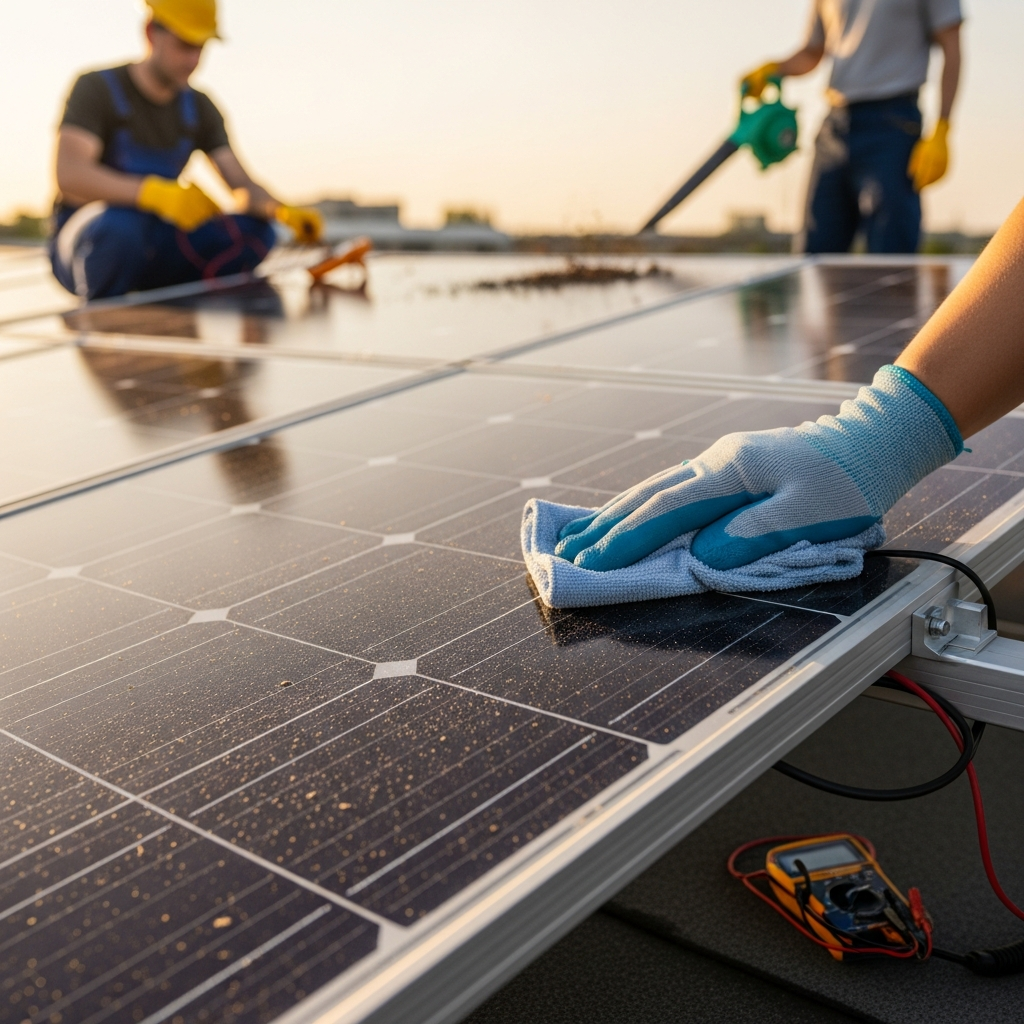
You must only clean panels between 6 AM and 8 AM or late in the evening. Spraying cold water on panels baking in the 45°C Indian afternoon sun will cause severe thermal shock and shatter the glass. Additionally, India's high TDS groundwater leaves chalky hard water scaling, so you must wipe the glass completely dry using a rubber squeegee.
Avoid harsh detergents, abrasive sponge pads, and high-pressure washers at all costs. These aggressive tools will strip away the delicate anti-reflective coating and permanently destroy the waterproof silicone seals. Stick to pure water and soft-bristled brushes.
B. Frequency of Cleaning Based on Location
If you live in urban or industrial hubs like Delhi, Mumbai, or Kanpur, you need bi-weekly cleaning to remove sticky smog. In dry, arid regions like Rajasthan or Gujarat, opt for weekly dry-brushing followed by a monthly wet wash to conserve water. For rainy coastal areas like Kerala or Goa, the rain washes the dust, but you must do a quarterly check for salt buildup and algae.
C. Seasonal Maintenance Calendar for India
- Pre-Monsoon (May/June): Execute a deep wet clean, clear your roof drains, and check for exposed wires before heavy rains arrive.
- Monsoon (July-Sept): Constantly clear fallen wet leaves that cause hot spots, and look out for fungal or algae growth under the panel edges.
- Winter (Nov-Feb): The thick morning dew mixes with winter smog to form a stubborn smog-mud, requiring frequent wiping with a microfiber mop.
Section 3: Technical Inspection & Hazard Prevention
A. Inverter Health & Monitoring
The inverter is the absolute "brain" of your solar power plant. During scorching Indian summers, you must ensure your inverter has proper ventilation to keep it cool and prevent thermal throttling. Whether you are reading up on on grid vs off grid solar india, always monitor your Wi-Fi app weekly to spot sudden generation drops indicating a fault.
B. Structural Integrity & Mounting Structures
Routinely inspect your Galvanized Iron (GI) or Aluminum mounting structures for any signs of rust or corrosion. Tightening the nuts and bolts is absolutely crucial preparation for the high-wind events and cyclones common in coastal and eastern India. Furthermore, carefully check the civil anchoring points on your roof to ensure no water leakage compromises your ceiling.
C. Local Hazard Management (Wildlife & Pests)
The monkey menace is real in India, and monkeys jumping on panels can cause invisible micro-cracks that cripple efficiency. Pigeons love nesting beneath warm panels, while rats often chew through critical DC cables. Install sturdy bird meshes around the panel perimeter and run all wiring through heavy-duty PVC conduits to stop rodents.
Section 4: Top 3 Product Comparison: Best Solar Cleaning Kits in India
Finding the right tools can save you hours of labor and protect your panels from scratches. Below is a comparison of the best solar cleaning gear available for Indian homeowners.
| Rank | Product Name | Best For | Buy Link |
|---|---|---|---|
| #1 | Telescopic Water-Fed Pole | 2-to-3 story independent houses | Buy Telescopic Water-Fed Pole |
| #2 | Microfiber Mop & Squeegee Combo | Flat RCC terraces | Buy Microfiber Mop Squeegee Combo |
| #3 | Solar Cleaning Descaler Liquid | Homes with high TDS hard water | Buy Solar Cleaning Descaler Liquid |
1. The Premium Telescopic Water-Fed Pole System
This is a game-changer for homeowners with sloped roofs or massive arrays. It features an expandable pole (often reaching up to 20 feet), an integrated water hose, and a specialized soft-bristle brush. * Pros: Cleans safely from the ground level; highly efficient and saves immense time. * Cons: Quite expensive (₹4,000 - ₹8,000); demands good municipal water pressure to work optimally.
2. The Microfiber Mop & Squeegee Combo Kit
For homes with easily accessible flat RCC roofs, this is the most practical tool. It combines a non-abrasive microfiber pad for scrubbing on one side and a rubber squeegee on the other to eliminate water marks. * Pros: Highly budget-friendly (₹800 - ₹1,500); completely prevents chalky hard water scaling. * Cons: Labor-intensive manual work; requires a separate bucket or hose.
3. Solar-Specific Liquid Cleaning Solution / Descaler
When dealing with stubborn bird droppings, tree sap, or heavy industrial pollution, plain water isn't enough. These bio-degradable, pH-neutral liquids dissolve grime without harming the delicate anti-reflective coating. * Pros: Restores full panel efficiency; completely safe for panel seals (₹500 - ₹1,200/liter). * Cons: It is a recurring cost; requires careful mixing and application.
Verdict: If you have a flat roof, grab the Buy Microfiber Mop Squeegee Combo. If your water is highly saline, supplement it with the Buy Solar Cleaning Descaler Liquid.
Section 5: Professional Servicing, Warranties, & AMCs
A. DIY vs. Professional Maintenance: Drawing the Line
Homeowners should strictly limit their DIY work to glass cleaning, visual checks, and monitoring the Wi-Fi app. Anything electrical requires a certified technician to step in. Never attempt to replace burnt MC4 connectors, diagnose inverter error codes, or conduct grounding tests yourself.
B. Understanding Your Solar Warranties
Your system comes with a 10-12 year Product Warranty and a massive 25-year Performance Warranty. However, using a steel wire brush, harsh chemicals, or high-pressure jets will instantly void these manufacturer guarantees. Always document your maintenance appropriately to keep your warranty valid.
C. The Value of an Annual Maintenance Contract (AMC)
A standard solar AMC for an Indian residential system costs between ₹2,000 to ₹5,000 per year. Demand an AMC that includes bi-annual deep cleaning, electrical string testing, and thermal imaging to spot hidden hot spots. A good provider will also assist in liaisoning with the local DISCOM if any net-metering billing discrepancies arise.
D. Conclusion & Next Steps
Regular, careful maintenance directly protects your financial investment and maximizes your long-term energy savings. By taking simple proactive steps, you contribute massively to a greener, more sustainable India. Schedule your pre-monsoon inspection today, and secure your AMC to keep your solar plant running flawlessly for decades.
Conclusion
Taking care of your solar panels is a direct investment in your long-term energy independence and financial savings. By following these straightforward maintenance tips—such as routinely clearing away debris, scheduling annual professional inspections, and actively monitoring your system's output—you can ensure your array operates at peak efficiency for decades. A well-maintained solar energy system minimizes unexpected repair costs, maximizes your return on investment, and shrinks your carbon footprint. Don't wait for a noticeable drop in power production to start caring for your panels; embrace proactive maintenance today and let the sun reliably power your home for years to come.
Frequently Asked Questions
How often should I clean my solar panels?
Generally, it is recommended to clean your solar panels once or twice a year. However, if you live in an area prone to high dust, heavy pollen, frequent bird droppings, or very little rainfall, you may need to clean them three to four times a year to maintain optimal energy production.
Can I clean my solar panels myself, or do I need a professional?
You can safely clean your solar panels yourself from the ground using a long-handled soft brush and a hose with plain water. However, if your panels are located on a steep or highly elevated roof, or if they have hard-to-remove grime, hiring a professional solar cleaning service is highly recommended to ensure your safety and prevent accidental damage to the glass.
How do I know if my solar panels need maintenance?
The clearest indicator that your panels need maintenance is a sudden, unexplained drop in daily energy output, which you can track via your solar monitoring app. Other common signs include a visible build-up of dirt or debris, physical damage such as micro-cracks in the glass, or error alerts flashing on your system's inverter.