Best Solar Brands in India: Tata vs Luminous
Choosing a solar brand in India? This guide dives deep into the top contenders, focusing on giants like Tata Power Solar and Luminous. We compare their solar panels, inverters, and battery systems on key factors like cost, warranty, and customer service. See how they stack up against other leading b
- Section 1: The Rooftop Solar Revolution in India – Why Act Now?
- Section 2: Deep-Dive Analysis: Tata Power Solar vs. Luminous
- Section 3: Top 3 Product Category Comparison (Tata vs. Luminous)
- Section 4: Navigating Costs, Subsidies, and ROI in India
- Section 5: The Homeowner’s Step-by-Step Buying Guide & Checklist
- 5.1 Assessing Your Home’s Readiness
- 5.2 Choosing the Right Vendor/Installer
- 5.3 The Pre-Installation Checklist (Must-Ask Questions)
- 5.4 Conclusion & Final Recommendation
- Conclusion: Choosing Your Solar Champion
- Frequently Asked Questions (FAQ)
- Which is better for a typical home in India, Tata Solar or Luminous?
- Is Tata Solar significantly more expensive than Luminous?
- How does the after-sales service of Tata Solar compare to Luminous?
- ⚡ Get 3 Free Solar Quotes
Key Takeaways: * Act Now for Maximum Savings: With the new "PM Surya Ghar Muft Bijli Yojana" offering up to ₹78,000 in subsidies, the return on investment for a home solar system has dropped to a record low of 3-5 years. * Tata for Premium On-Grid: Choose Tata Power Solar if you are in a metro city, want a zero-hassle, "fill it, shut it, forget it" on-grid system to eliminate your electricity bill, and have a higher upfront budget. * Luminous for Rugged Off-Grid: Choose Luminous if you live in an area with frequent power cuts, need a reliable battery backup (hybrid/off-grid system), and prioritize affordability and widespread local service.
Section 1: The Rooftop Solar Revolution in India – Why Act Now?
1.1 The Pain Point & The Solution
Are you tired of skyrocketing electricity bills, especially during peak summer? Do you dread the frequent power cuts and load shedding that disrupt your life and work? You are not alone. Across India, rising electricity tariffs are eating into household budgets.
But there's a permanent solution. Rooftop solar is no longer just an expense; it’s an appreciating asset that generates free electricity for over 25 years. It’s your personal power plant, right on your roof.
1.2 The "PM Surya Ghar Muft Bijli Yojana" Effect
The Indian government has supercharged the solar movement with its new subsidy scheme. The "PM Surya Ghar Muft Bijli Yojana" provides direct financial assistance, offering a subsidy of up to ₹78,000 for a 3kW system.
This game-changing incentive has slashed the payback period for a home solar investment. For the average Indian homeowner, the Return on Investment (ROI) is now an incredible 3 to 5 years. After that, it's decades of free, clean power.
1.3 The Maze of Solar Brands
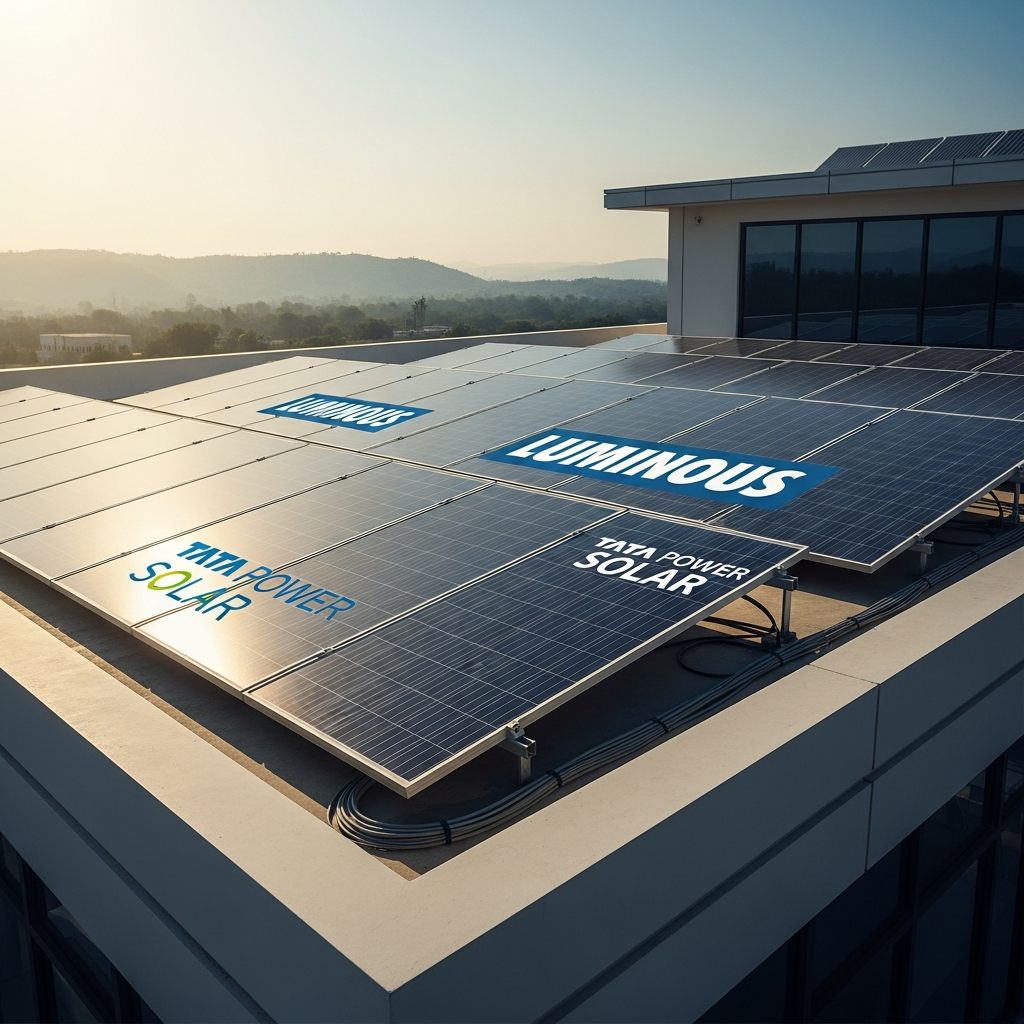
The Indian solar market is flooded with options, from local assemblers to international giants, causing massive confusion for buyers. To cut through the noise, this guide focuses on the two brands that have earned unwavering consumer trust: Tata Power Solar and Luminous.
We'll dissect Tata Power Solar (The Premium Giant) and Luminous (The Household Reliable) to help you decide which is the perfect fit for your home, budget, and power needs.
Section 2: Deep-Dive Analysis: Tata Power Solar vs. Luminous
2.1 Tata Power Solar: The Premium Powerhouse
With over 30 years in the solar industry and the formidable backing of the Tata conglomerate, this brand is synonymous with trust and quality. Tata Power Solar is not just a component seller; they are an end-to-end solution provider.
Their "EPC" (Engineering, Procurement, Construction) approach means they manage the entire project for you, from system design to installation and seamless net-metering assistance. They focus on high-efficiency Mono PERC and Bifacial panels, ensuring maximum power generation from your roof.
- Pros:
- Unmatched brand trust and reliability.
- Complete end-to-end solution for a hassle-free experience.
- Excellent net-metering and subsidy paperwork assistance.
- Robust 25-year performance warranties on their panels.
- Cons:
- Commands a premium price compared to the competition.
- Longer installation wait times in some cities due to high demand.
2.2 Luminous: The Off-Grid & Hybrid Champion
Owned by the global energy giant Schneider Electric, Luminous is a household name in India, famous for its inverters and batteries. This incredible brand recall and retail penetration mean you can find their products and service centers even in Tier-2, 3, and 4 cities.
Luminous excels in product versatility. Their strength lies in their unbeatable ecosystem of solar inverters (PCUs), and industry-leading solar tubular batteries, making them the default choice for areas plagued by power cuts.
- Pros:
- Highly affordable and budget-friendly solutions.
- The best ecosystem for off-grid and hybrid systems with battery backup.
- Vast service network with fast, local support.
- Products are readily available across the country.
- Cons:
- Often a fragmented system (panels from one OEM, inverter from Luminous), not a single proprietary package like Tata.
- The core expertise is in power electronics (inverters/batteries) more than panel manufacturing itself.
2.3 Head-to-Head Verdict
The choice between Tata and Luminous is clear and depends entirely on your needs.
- Choose Tata Power Solar if: You live in a metro or Tier-1 city, your primary goal is a zero-bill On-Grid system, you have a higher upfront budget, and you want a premium, hands-off installation experience.
- Choose Luminous if: You live in an area with frequent and long power cuts, require a robust battery backup (Off-Grid/Hybrid system), are working with a tighter budget, and value immediate local servicing.
Section 3: Top 3 Product Category Comparison (Tata vs. Luminous)
Let's see how these two giants stack up with specific product offerings for the most common home solar setups.
Product Comparison Table
| Rank | Product Name | Best For | Link |
|---|---|---|---|
| 1 | Tata Power Solar EZ Home Rooftop Solution | Premium On-Grid, Zero Bills | Check Price |
| 2 | Luminous Solarverter Pro Hybrid System | Surviving Power Cuts (Hybrid) | Check Price |
| 3 | Luminous Novergy Mono PERC Panels | Individual Panel Purchase | Check Price |
Comparison 1: The 3kW On-Grid Rooftop System (Best for Eliminating Electricity Bills)
- Tata Offering: The Tata Power EZ Home Rooftop Solution is a complete package. It includes high-efficiency Mono PERC panels, a Tata-branded string inverter, galvanized mounting structures, and end-to-end installation and paperwork handling. While some users explore alternatives like the best microinverter brands for complex roofs, Tata's string inverter solution is optimized for cost and efficiency for most Indian homes.
- Luminous Offering: A Luminous Grid-Tie Solar System typically combines Novergy Panels with a Luminous GTI series string inverter. It's a reliable and more budget-friendly setup.
- Winner/Verdict: Tata wins. The seamless, single-window experience for installation, subsidy claims, and net-metering makes their premium price worthwhile for on-grid customers who want zero hassle.
Comparison 2: The 3kW to 5kW Off-Grid/Hybrid System (Best for Areas with Power Cuts)
- Tata Offering: Tata Power offers off-grid solutions, but their core strength is on-grid. Their systems often require pairing with third-party battery banks, which can complicate service.
- Luminous Offering: This is Luminous's home ground. A system built around the Luminous Solarverter Pro PCU paired with their iconic Luminous Solar Tubular Batteries is the gold standard in India. This combination is engineered to work flawlessly together, making it one of the best hybrid solar inverter for home setups available.
- Winner/Verdict: Luminous wins flawlessly. Their integrated ecosystem of solar PCUs and deep-cycle batteries is purpose-built to endure long Indian power outages, offering unmatched reliability and performance.
Comparison 3: High-Efficiency Solar Panels (Individual Component Upgrade)
- Tata Offering: Tata Power Mono PERC Half-Cut Cell Panels (400W - 540W+) are known for their build quality and extremely low solar panel degradation rate, ensuring high performance for decades.
- Luminous Offering: Luminous Novergy Mono PERC Panels are equally robust, offering excellent performance, especially in low-light conditions, and are widely available.
- Winner/Verdict: Tie. Both brands offer Tier-1 quality panels with 25-year performance warranties that are certified to withstand harsh Indian weather. The best choice often comes down to local dealer pricing and availability.
Section 4: Navigating Costs, Subsidies, and ROI in India
4.1 Real-World Pricing Breakdown (3kW System)
These are benchmark figures before subsidy. Prices can vary based on your city, roof type, and choice of components.
- Estimated Luminous Cost: ₹1,40,000 – ₹1,65,000. The lower end is for on-grid, while the higher end includes the cost of batteries for an off-grid/hybrid system.
- Estimated Tata Cost: ₹1,60,000 – ₹1,90,000. This reflects their premium, end-to-end on-grid package pricing.
4.2 Claiming the National Subsidy
Getting your subsidy is a straightforward process via the government's National Portal for Rooftop Solar.
- Register on the
pmsuryaghar.gov.inportal. - Your chosen vendor (like Tata or a Luminous dealer) will submit the technical feasibility report.
- After installation and inspection by the DISCOM (electricity board), a net meter will be installed.
- Once the commissioning report is generated, you submit your bank details, and the subsidy is credited directly to your account within 30 days.
Crucial Point: Subsidies are ONLY available for On-Grid systems using DCR (Domestic Content Requirement) Made-in-India panels. Both Tata and Luminous offer certified DCR modules.
4.3 Calculating Your ROI
Let's see how quickly your investment pays for itself.
- Assume your pre-solar monthly electricity bill is ₹3,000 (₹36,000 annually).
- Your total 3kW system cost is ₹1,80,000. After a ₹78,000 subsidy, your net investment is ₹1,02,000.
- Your post-solar bill drops to nearly ₹200 (for fixed charges). Your annual saving is ~₹33,600.
- Payback Period: ₹1,02,000 / ₹33,600 = ~3 years!
After 3 years, you get free electricity for the next 22+ years of the system's life.
4.4 Solar Financing (EMIs)
Don't have the upfront capital? No problem. Major banks like SBI, HDFC, ICICI, and several NBFCs offer dedicated solar loans at very attractive interest rates, often between 7% and 9%.
Section 5: The Homeowner’s Step-by-Step Buying Guide & Checklist
5.1 Assessing Your Home’s Readiness
Before you call a dealer, check these two things:
- Shadow-Free Roof Space: You need approximately 100 sq. ft. of clear, shadow-free area (from trees, water tanks, etc.) for every 1kW of solar capacity. A 3kW system needs about 300 sq. ft.
- Sanctioned Load: Look at your electricity bill. Your "Sanctioned Load" (in kW or kVA) should ideally be equal to or greater than the solar system capacity you plan to install.
5.2 Choosing the Right Vendor/Installer
This is the most critical step. Avoid fly-by-night local assemblers who offer suspiciously low prices.
Always choose an officially recognized partner. Look for Tata Power Solar Authorized Channel Partners or official Luminous Solar Hubs in your city. This guarantees you get genuine products and proper installation.
5.3 The Pre-Installation Checklist (Must-Ask Questions)
Ask your installer these questions before signing any contract:
- Is the mounting structure hot-dip galvanized to prevent rusting during monsoons?
- Are you using DC-grade, UV-protected cables specifically designed for solar?
- Will you handle all the DISCOM (Electricity Board) paperwork for net-metering and approvals?
- What is the warranty on the inverter and the installation workmanship?
5.4 Conclusion & Final Recommendation
Investing in solar is one of the smartest financial decisions an Indian homeowner can make today. Both Tata Power Solar and Luminous are exceptional, top-tier brands that you can trust.
The final choice boils down to a simple rule of thumb:
- Final Rule of Thumb: Go with Tata Power Solar for a premium, hassle-free on-grid investment designed to zero out your electricity bills. Go with Luminous for a rugged, affordable, battery-backed hybrid system built to survive relentless power cuts.
Call to Action: Your journey to energy independence starts now. Pick up your latest electricity bill, calculate your required system size, and book a site survey with an authorized Tata or Luminous dealer today.
Conclusion: Choosing Your Solar Champion
Choosing between solar giants like Tata Power Solar and Luminous isn't about picking an outright winner, but about aligning a brand's core strengths with your specific priorities. Both are formidable players in India's solar landscape, but they cater to slightly different consumer profiles.
Tata Power Solar is the embodiment of trust, legacy, and engineering excellence. If your primary concern is securing a premium, end-to-end solar solution with high-efficiency, Tier-1 panels backed by one of India's most respected names, Tata is an unparalleled choice. It represents a long-term, high-performance investment where quality and reliability are paramount.
Luminous, on the other hand, leverages its unparalleled dominance and expertise in the power backup market. If you are looking for a strong value proposition, exceptional reliability in inverters and batteries, and the assurance of a vast, accessible service network that reaches every corner of the country, Luminous is your ideal partner. They offer a robust and pragmatic solution that is both trusted and cost-effective.
Your final decision should be simple: * Choose Tata Power Solar for a premium, panel-centric system backed by a legacy of engineering. * Choose Luminous for a value-driven system built around best-in-class power backup components and an unbeatable service network.
Ultimately, both brands are leading India's green energy transition. By choosing either, you are investing in a sustainable future powered by a reliable industry leader.
Frequently Asked Questions (FAQ)
Which is better for a typical home in India, Tata Solar or Luminous?
Both are excellent choices. If your priority is the absolute highest quality and efficiency in solar panels from a vertically integrated company, Tata Power Solar is a top contender. If you prioritize the inverter and battery system (the "brains" of the setup) and want the assurance of a massive, easily accessible service network, Luminous has a distinct advantage due to its legacy in power backup solutions.
Is Tata Solar significantly more expensive than Luminous?
Generally, Tata Solar can be positioned as a premium brand, and its initial quotes may be higher. This often reflects their use of high-efficiency Tier-1 panels and comprehensive project management services. Luminous often presents a very strong value proposition, providing highly competitive pricing, especially when bundling their market-leading inverters and batteries. The final cost will depend on system size, components chosen, and location.
How does the after-sales service of Tata Solar compare to Luminous?
Both brands have strong service commitments. Tata Power Solar offers a structured, corporate service network befitting its brand stature. However, Luminous has an arguably more extensive and dense grassroots service network due to its decades of selling inverters and batteries across India. For customers in more remote areas, the local presence of a Luminous service professional might be more readily available.