Best Hybrid Solar Inverters for Home in 2024
Looking to upgrade your residential solar setup? A hybrid solar inverter combines solar and battery storage to keep your house powered during outages while cutting electricity bills. Explore our expert guide to the best hybrid solar inverters for home use, featuring top brands and buying tips.
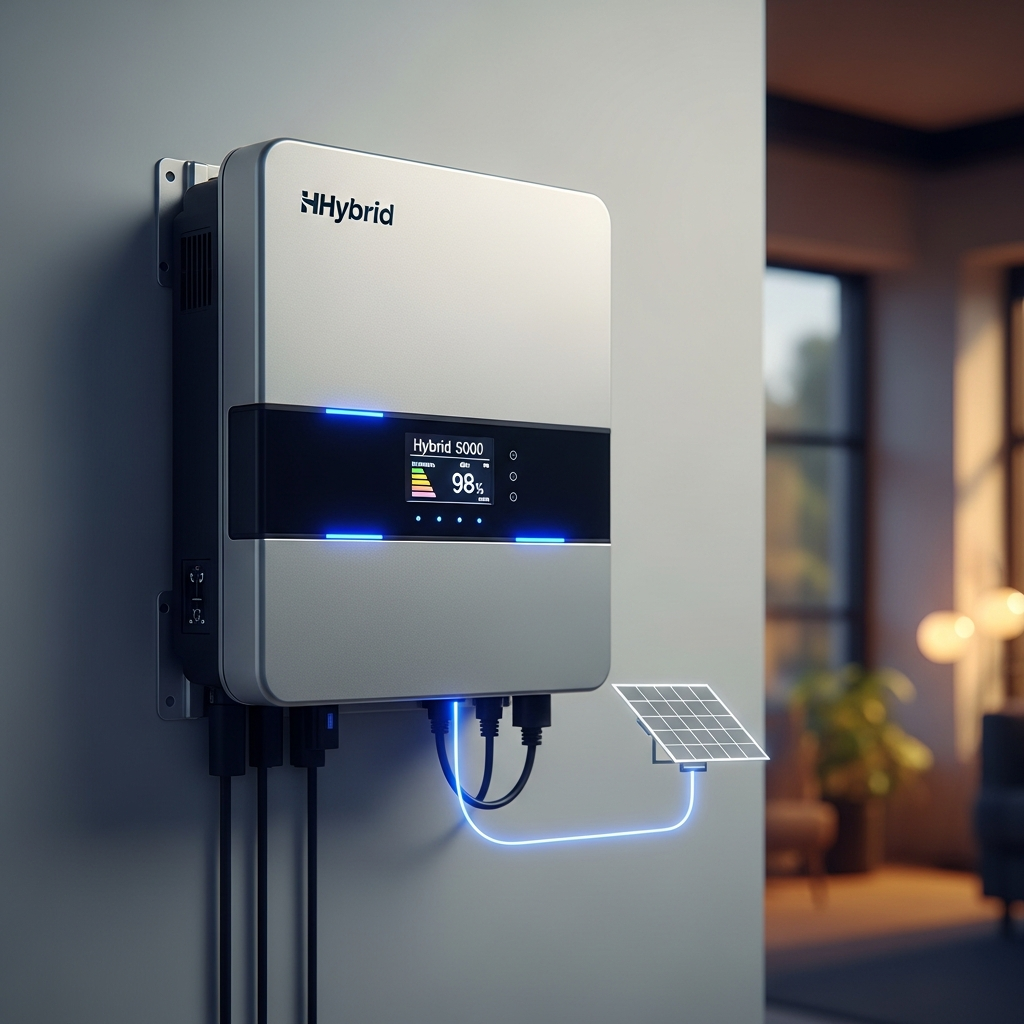
The Ultimate Guide to the Best Hybrid Solar Inverters for Indian Homes
Section 1: Demystifying Hybrid Solar Inverters for the Indian Context
Transitioning to solar power in India requires navigating a unique power landscape characterized by fluctuating grid stability and rising energy tariffs. To maximize your investment, choosing the right inverter is critical.
1.1 What is a Hybrid Solar Inverter?
A hybrid solar inverter acts as the "All-in-One" brain of your home’s energy system. It intelligently manages the flow of direct current (DC) power from your solar panels, converting it into usable alternating current (AC) power, while simultaneously communicating with the state electricity grid (DISCOM) and your battery bank.
Here is how a hybrid setup compares to older technologies:
| Feature | On-Grid Solar System | Off-Grid Solar System | Hybrid Solar System |
|---|---|---|---|
| Grid Connection | Yes (Exports excess power) | No | Yes (Exports excess power) |
| Battery Backup | No | Yes | Yes |
| During Power Cuts | Fails. Shuts down automatically for grid safety (anti-islanding). | Works perfectly. | Works perfectly. Switches to battery seamlessly. |
| Power Wastage | None. | High. Excess summer power is wasted once batteries are full. | None. Full batteries? Excess is exported to the grid. |
1.2 Why Indian Homes Need Hybrid Systems Today
- The Power Cut Factor: While major metros have relatively stable power, scheduled load-shedding and sudden monsoon-induced outages are realities across Indian tier-2 cities and suburbs. A hybrid inverter ensures uninterrupted power.
- The Tariff Factor: With residential per-unit costs climbing rapidly in states like Maharashtra (up to ₹12/unit), Karnataka, UP, and Delhi, relying entirely on the grid is becoming economically unsustainable.
- Net Metering: Hybrid inverters support net metering. During the day, they export excess solar power to the grid. Your DISCOM credits you for this power, practically reducing your electricity bill to zero.
1.3 Understanding Your Home’s Load Profile
Proper inverter sizing starts with categorizing your loads: * Essential Loads (Low-Surge): BLDC Fans, LED lights, Wi-Fi routers, Laptops, and LED TVs. * Heavy Loads (High-Surge): Inverter ACs, Geysers, 0.5 to 1 HP Water/Tullu Pumps, and Microwaves.
Case Study Data: A standard urban 3BHK typically requires a 3kW to 5kW hybrid system to run 1-2 inverter ACs and essential loads. Conversely, a Tier-2 independent villa running agricultural water pumps might require a robust 5kW to 8kW system to handle massive starting surges.
Section 2: The Ultimate Buyer’s Guide – Key Technical Specs to Look For
Look past the marketing jargon. To ensure your system survives Indian environmental conditions, these are the specifications that matter.
2.1 Inverter Capacity (kVA/kW) & Surge Power
- Sizing the Inverter: Always follow the "80% Load Rule." If your total simultaneously running load is 2,400 Watts, you need a minimum 3kVA (3,000 Watts) inverter. Running an inverter at 100% capacity constantly degrades its lifespan.
- Surge Capacity (Peak Power): Indian water pumps and older non-inverter ACs draw 2x to 3x their running watts upon startup. If your hybrid inverter lacks a high surge rating (e.g., handling 6kW surges on a 3kW inverter for 5 seconds), it will trip constantly.
2.2 Battery Compatibility & Voltage (The Heart of the Backup)
Choosing the right battery chemistry is crucial for long-term ROI. When comparing a lifepo4 vs lead acid solar battery, Lead-Acid (Tall Tubular) offers lower upfront costs but requires maintenance and takes up significant space. Lithium-ion (LiFePO4) is compact, maintenance-free, and boasts a 10-year lifespan, making it ideal for cramped urban apartments. * System Voltage: For standard home setups, 12V and 24V systems are largely outdated. 48V is the gold standard for 3kW-5kW hybrid inverters, offering greater efficiency, thinner cabling, and less heat generation.
2.3 MPPT Technology (Maximum Power Point Tracking)
Older PWM (Pulse Width Modulation) inverters waste up to 30% of your solar power. MPPT is non-negotiable—it extracts the absolute maximum power from your panels regardless of cloud cover. * Dual MPPT: Indian roofs are often complex. If you must place half your panels on a South-facing roof and half on an East-facing roof, a Dual MPPT inverter manages these two "strings" independently, preventing shaded panels from dragging down the performance of the sunny ones.
2.4 Built for India: Durability and Safety Standards
- BIS Certification: The Bureau of Indian Standards (BIS) certification is legally mandatory to connect your system to the grid and to claim government subsidies.
- IP Rating: Look for an IP65 rating (dust and water resistance). This protects internal components from high humidity, monsoon moisture, and heavy North Indian summer dust.
- Cooling Mechanisms: Ensure the unit features transformerless designs with active fan cooling to handle India's 45°C+ peak summer temperatures.
Section 3: Top Hybrid Solar Inverter Recommendations in India (2024)
Top 3 Product Comparison
| Feature | Best Overall | Best Budget | Best Premium |
|---|---|---|---|
| Model | Luminous Solarverter Pro | Microtek Solar PCU | Growatt SPH Series |
| Capacity | 3kVA - 5kVA | 2kVA - 3kVA | 3kW - 6kW |
| Technology | Advanced MPPT | MPPT | Dual MPPT |
| Battery Compatibility | Lead Acid / Lithium | Primarily Lead Acid | Lithium Ready (Built-in BMS) |
| Best For | Average 3BHK Homes | Tier-2/3 Homes | Tech-Savvy Urban Villas |
3.1 Best Overall Hybrid Inverter (The Balanced Choice)
- Recommended Models: Luminous Solarverter Pro / Havells Enviro
- Why it wins: These inverters strike the perfect balance between upfront cost, highly efficient MPPT technology, and a massive Pan-India service network. If a component fails in a Tier-2 city, Luminous and Havells technicians are readily available.
- Ideal for: The average 3BHK running 1 AC, a refrigerator, and standard daily appliances.
3.2 Best Budget-Friendly Hybrid Inverter
- Recommended Models: Microtek Solar PCU / UTL Alfa
- Why it wins: Offering excellent value for money, these units are highly compatible with traditional tall tubular batteries that are cheap to procure locally.
- Ideal for: Tier-2/Tier-3 city homes that experience frequent, extended power outages but predominantly run minimal heavy loads (fans, lights, TVs).
3.3 Best Premium/High-Tech Hybrid Inverter (Lithium-Ready)
- Recommended Models: Growatt SPH Series / Deye Hybrid
- Why it wins: These represent the pinnacle of smart-home integration. They feature Dual MPPT, ultra-high conversion efficiencies (97%+), Wi-Fi monitoring apps, and a built-in BMS (Battery Management System) optimized specifically for modern Lithium batteries.
- Ideal for: Modern urban villas and tech-savvy homeowners wanting precise energy monitoring and zero grid-reliance.
3.4 Best Heavy-Duty Inverter (For High Surge Loads)
- Recommended Models: Genus Surja / SolarEdge
- Why it wins: These beasts feature massive surge capacities and ultra-durable copper-wound transformers. They seamlessly absorb the shock of heavy inductive loads.
- Ideal for: Homes running multiple ACs simultaneously, agricultural water pumps, or heavy commercial-style loads.
Section 4: Economics, Government Subsidies, and Installation
The biggest friction points for Indian buyers are calculating the return on investment (ROI) and navigating bureaucratic hurdles. Here is the data-driven reality.
4.1 Navigating the PM Surya Ghar: Muft Bijli Yojana
The Government of India has heavily incentivized solar adoption. However, it is vital to understand that subsidies apply only to the solar panels and the grid-tie components—not the battery bank. * Subsidy Structure: You can claim up to ₹78,000 for a 3kW (or higher) system. * The DISCOM Role: To activate net metering with your hybrid inverter, your state DISCOM must test the setup, ensure your inverter is BIS-certified, and replace your traditional meter with a bidirectional net meter.
4.2 Total Cost of Ownership & ROI Calculation
A standard 3kW Hybrid Setup has the following estimated breakdown (pricing varies by brand and state): * Hybrid Inverter (3kW): ₹45,000 - ₹60,000 * Solar Panels (3.3kWp): ₹70,000 * Lithium Battery (48V, 100Ah): ₹80,000 * Installation, BOS (Cables, Mounts): ₹30,000 * Approximate Total (Pre-Subsidy): ₹2,25,000 to ₹2,40,000
Calculating Payback: A 3kW system generates roughly 12-14 units a day. If you save ₹3,000 to ₹5,000/month on electricity bills, your payback period is typically 4 to 6 years. Keep in mind the solar panel degradation rate over time, though top-tier panels will still operate at over 80% efficiency in year 25.
4.3 Installation Best Practices for Indian Roofs
- Space & Ventilation: Never install your hybrid inverter in direct sunlight, poorly ventilated "chajjas," or damp basements. Heat is the enemy of power electronics. Keep it in a shaded, well-ventilated utility area.
- Safety Gear is Mandatory: Ensure your installer uses AC/DC Distribution Boxes (DBs), DC Surge Protection Devices (SPDs) to protect the inverter from lightning strikes, and proper deep-earth chemical grounding.
Section 5: Long-Term Maintenance, Warranties, and FAQs
5.1 Understanding Warranties in India
Hybrid inverters usually carry a standard warranty of 5 to 10 years. Batteries range from 3–5 years (Tubular Lead-Acid) to 10 years (Lithium LiFePO4). Always prioritize brands that offer "on-site" service in your specific pin code. "Carry-in" service means you are responsible for uninstalling a heavy 30kg inverter and driving it to a service center.
5.2 Routine Maintenance Checklist
- Inverter Care: Monthly dusting of the air cooling vents ensures the fans don't get choked. Periodically check the mobile app or LCD for any flashing error codes.
- Panel Care: Dust significantly drops solar yields. Implement practical solar panel maintenance tips like washing the panels every two weeks, especially in high-dust regions like North India, to maintain peak inverter efficiency.
5.3 Frequently Asked Questions (Homeowner Pain Points)
Can I run my 1.5-ton Inverter AC on a 3kW hybrid inverter during a power cut? Yes, but with caveats. A modern 1.5-ton inverter AC draws about 1,200W–1,500W. A 3kW inverter can handle this easily, provided your battery bank is sized appropriately (e.g., a 48V 100Ah lithium battery) to sustain that high draw without quickly depleting. Ensure you aren't simultaneously running a geyser or microwave.
Can I install the inverter now and add the solar panels/batteries later? Yes! A hybrid inverter can function purely as a standard UPS (grid + battery) first. You can add solar panels later as your budget allows.
Do I still have to pay a fixed meter charge to the electricity board? Yes. Even if your net metering reduces your actual power consumption bill to zero, state DISCOMs still levy a small monthly "fixed charge" (usually ₹150 - ₹400 depending on your sanctioned grid load) for utilizing grid infrastructure.
Is my society/RWA permission required to install a hybrid system? Yes, if you live in an apartment complex or gated society. You need an NOC (No Objection Certificate) from your RWA to utilize roof space and process the net metering application with the local electricity board.
Conclusion
Investing in the best hybrid solar inverter for your home is the ultimate step toward true energy independence. By seamlessly managing power between your solar panels, battery storage, and the utility grid, a high-quality hybrid inverter maximizes your energy savings and ensures your lights stay on during unpredictable power outages. Whether you prioritize a high surge capacity, seamless battery integration, or smart-home monitoring, choosing the right unit will future-proof your solar setup. Evaluate your household’s specific energy needs, consult with a certified installer, and make the switch to a hybrid system that works tirelessly day and night to power your life efficiently.
Frequently Asked Questions (FAQ)
1. What is a hybrid solar inverter and do I really need one? A hybrid solar inverter combines a traditional grid-tied solar inverter and a battery inverter into a single, compact unit. You need one if you plan to install solar batteries (now or in the future) to store excess solar energy for nighttime use, or if you want backup power during grid outages while still keeping the ability to sell excess power back to the grid.
2. What size hybrid solar inverter do I need for my home? The ideal size depends on your household's peak energy consumption and the overall size of your solar panel array. For an average-sized home, a 5kW to 8kW hybrid inverter is typically sufficient. However, if you plan to run heavy loads like central air conditioning or electric vehicle chargers simultaneously, you may need a 10kW to 12kW unit.
3. Can a hybrid solar inverter work during a power outage? Yes! One of the biggest advantages of a hybrid solar inverter is its built-in "islanding" capability. During a grid blackout, the inverter safely disconnects from the grid and automatically begins drawing stored power from your battery system and solar panels, keeping your essential home appliances running seamlessly.